
Do Facebook ads for small business still deliver genuine returns, or are you simply pouring hard-earned revenue into a digital void? If you have wrestled with confusing dashboards, wasted ad spend, or a steady stream of low-quality leads, your frustration is entirely justified. Campaigns rarely stumble because Meta’s platform is broken; they fail because disjointed tactics quietly drain your budget before an algorithm can even learn who your ideal customer is.
You do not need an enterprise marketing budget to see profitable growth, nor must you waste hours deciphering technical jargon. In this guide, you will discover the truth behind Meta advertising and learn how to generate measurable ROI without leaking capital. We debunk five persistent myths holding small businesses back in 2026, equipping you with the clarity to launch campaigns with complete confidence and recognise precisely when to bring in an expert partner.
Key Takeaways
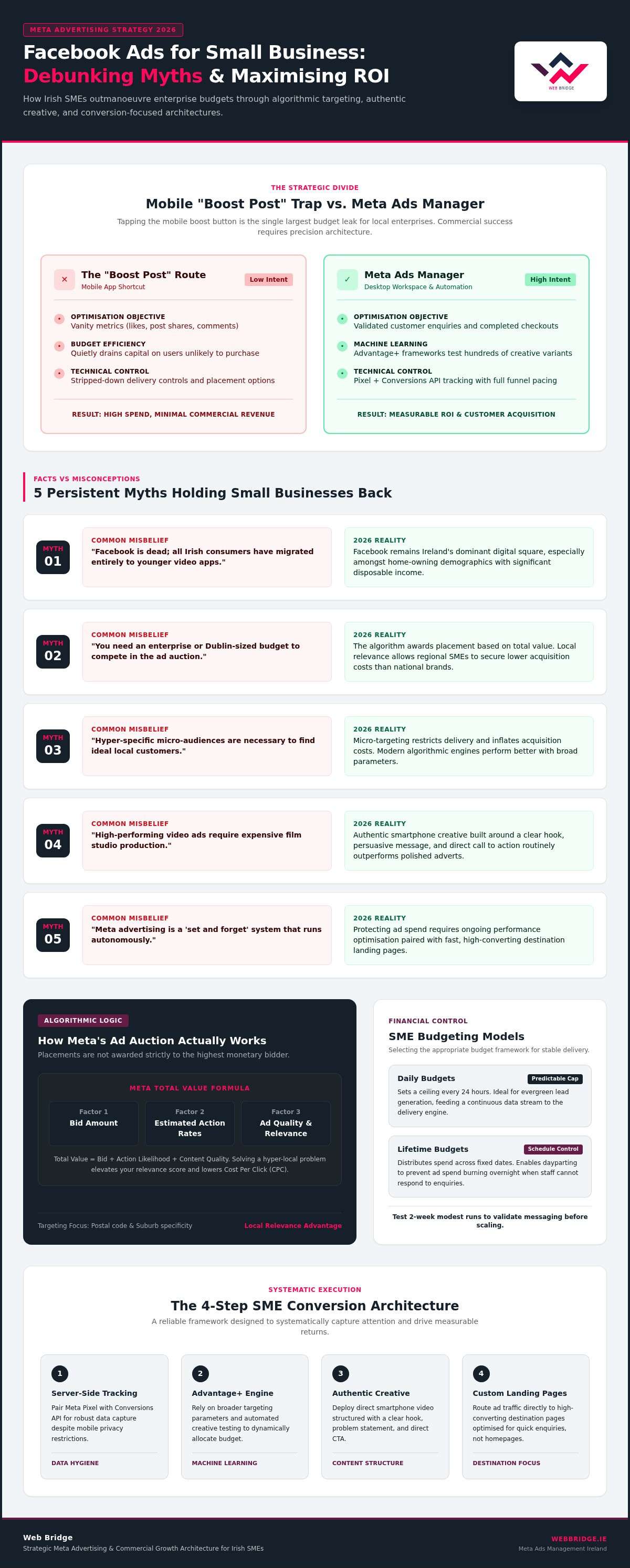
- Bypass the mobile “Boost Post” trap and use Meta Ads Manager to focus your budget on genuine commercial conversions rather than vanity likes.
- Running Facebook ads for small business does not demand an enterprise-sized budget; disciplined daily limits let you achieve measurable ROI at any scale.
- Let modern algorithmic targeting do the heavy lifting, as hyper-specific micro-audiences actually restrict ad delivery and inflate acquisition costs.
- Swap costly studio video production for direct, authentic smartphone creative built around a clear hook, persuasive message, and direct call to action.
- Protect your ad spend by pairing continuous performance optimisation with a fast, high-converting website instead of relying on a “set and forget” approach.
Beyond the Boost Button: The 2026 Reality of Facebook Ads
Tapping the blue “Boost Post” button on your mobile phone feels like an easy win, but it remains the single largest budget leak for local enterprises. Boosting simply signals Meta to find users likely to leave a like or share, entirely bypassing high-intent buyers. Professional Facebook ads for small business require Meta Ads Manager; this desktop workspace unlocks precise custom conversion goals, placement controls, and budget pacing that the simplified mobile app strips away.
Modern Meta advertising in 2026 runs on automated machine learning, specifically Advantage+ campaign frameworks. These automated engines test hundreds of creative combinations simultaneously, dynamically allocating your spend to users ready to purchase. A genuinely successful Facebook ad campaign is never an isolated promotional post, but rather an integrated multi-step funnel that systematically captures attention, nurtures trust, and drives high-value actions.
Myth #1: “Facebook is Dead for Small Businesses”
Despite headlines proclaiming that all attention has migrated to TikTok, Facebook remains Ireland’s dominant digital town square. Millions of Irish consumers log in weekly across broad age brackets, particularly home-owning demographics with significant disposable income. From Dublin trades to regional professional services, local search behaviour on the platform continues to generate commercial enquiries that younger video apps simply cannot replicate.
The Distinction Between Awareness and Conversion
Vanity metrics don’t keep your doors open. While social likes look encouraging on a dashboard, only validated customer leads and completed checkouts pay your operational overheads. Generating tangible commercial returns relies on tracking high-intent user actions across modern targeted advertising models that prioritise actual sales over cheap impressions.
- Server-side data hygiene: Pairing your Meta Pixel with the Conversions API captures genuine purchase signals despite strict mobile privacy settings.
- Destination optimisation: Driving qualified traffic directly to custom landing pages designed specifically for quick enquiries rather than generic homepages.
Stopping this costly trial-and-error often requires seasoned technical configuration. Choosing dedicated Meta Ads management Ireland ensures your tracking architecture is watertight, your targeting aligns with bottom-line revenue, and every euro invested actively pulls qualified customers through your funnel.
The Cost Misconception: Why You Don’t Need a “Dublin-Sized” Budget
Because Meta’s European headquarters sits in Dublin, local business owners frequently assume that ad auctions are reserved for deep-pocketed tech giants. In truth, running Facebook ads for small business is remarkably cost-effective because the auction algorithm prices inventory on individual user actions, not blanket sponsorship fees. You can outmanoeuvre multi-national corporations simply by maintaining tighter geographical focus and sharper local relevance.
Gaining control over your ad spend begins with picking the right budgeting model:
- Daily Budgets: Sets a predictable ceiling every 24 hours. This structure works best for evergreen lead generation, giving the delivery engine a steady stream of data.
- Lifetime Budgets: Distributes a fixed sum across a specific campaign schedule. It enables dayparting, which prevents ad spend from burning through the night when your staff cannot answer enquiries.
Targeting specific postal codes, such as South Dublin or North County suburbs, concentrates your budget where conversion likelihood is highest. Testing a modest budget over two weeks lets you validate your messaging before committing larger growth capital.
Myth #2: “You Need a Huge Budget to Compete”
Meta’s ad auction doesn’t simply award placement to the highest bidder. The delivery system prioritises total value, which balances bid amount with estimated action rates and ad quality. A local plumbing contractor in Swords or an artisan café in Ranelagh can routinely achieve cheaper customer acquisition than a national franchise. If your creative solves a specific neighbourhood problem, the algorithm rewards that relevance with lower costs per click.
Patience during the initial learning phase matters far more than an excessive budget. Modest, consistent daily spending provides the steady algorithmic data required to stabilise performance without draining your cash flow.
Calculating Your Potential ROI
Sound budgeting requires knowing your break-even Return on Ad Spend (ROAS). Divide your average order value or client lifetime value by your gross profit margin to determine your maximum allowable cost per acquisition. Aligning your baseline costs with realistic growth goals mirrors the core principles outlined in the U.S. Small Business Administration’s marketing guide on maintaining sustainable commercial outreach.
An exceptional ad campaign cannot fix a substandard destination. Directing paid traffic to a sluggish, cluttered website burns through your budget instantly, as frustrated mobile users bounce before filling out a form. Investing in professional Web Design Dublin ensures your landing pages load rapidly and convert clicks into paying customers, sealing the leaks in your sales funnel.
The Targeting Fallacy: Why “Broad” is Often Better for SMEs
Layering dozens of granular interest filters used to be standard practice, but micro-targeting in 2026 actually undermines campaign performance. Attempting to isolate “home renovation enthusiasts who like Italian marble” restricts the algorithm’s auction liquidity, sending your delivery costs soaring. Today, effective Facebook ads for small business rely on the ad creative itself to qualify prospects whilst Meta’s machine learning engine finds buyers across expansive audiences.
Modern delivery systems utilise your visual hooks and ad copy to locate potential clients naturally. When you trust algorithmic distribution, two targeting assets deliver consistent commercial value:
- Lookalike Audiences: Meta analyses your uploaded past buyer lists or CRM leads, identifying matching behavioural traits across thousands of local prospects who have never encountered your brand before.
- Geographic Radii: Service businesses operating in specific Dublin neighbourhoods can set a defined kilometre radius around their primary trading territory, eliminating ad waste in locations their teams cannot physically reach.
Myth #3: “I Need to Target Every Single Interest”
Granular interest stacking is obsolete. If your ad video speaks directly to kitchen renovations, viewers who ignore home design simply scroll past, whilst active homeowners pause to watch. Creative filtering does the segmenting for you without paying an auction premium for manual audience tags. When configuring local campaigns, keep your setup clean: select your trade region, set basic age boundaries, and leave specific interest fields completely empty.
The Power of Retargeting
Converting a warm visitor costs a fraction of acquiring a cold lead. Retargeting captures consumers who browsed your services or abandoned a booking form, reminding them to finish their enquiry. This strategy works best when high-intent search traffic feeds your visitor pool, which is where integrating organic SEO Services creates a steady stream of prospective buyers to retarget on Meta platforms.
Setting up high-intent retargeting takes minimal effort. Build a custom audience in Meta Ads Manager targeting users who viewed your contact page or added products to a basket over the last 30 days, excluding completed purchases. Deliver an ad addressing common hesitations, such as turnaround times or local customer reviews, and you will quickly recover sales that would otherwise drift away. If you run an online store, the principles behind effective Meta advertising for ecommerce show how retargeting abandoned baskets and product page visitors can dramatically reduce your cost per purchase.
Content and Creative: Debunking the Need for Film-Studio Quality
Hyper-polished, corporate adverts look like sales pitches, and social users naturally swipe past them. In 2026, raw authenticity wins the auction. Running profitable Facebook ads for small business does not require cinema-grade cameras, specialised lighting rigs, or Hollywood editing software. Content that mimics personal feeds, such as honest customer reviews or behind-the-scenes mobile walkthroughs, builds immediate trust and outperforms glossy advertisements every day.
Transforming ordinary viewers into commercial leads relies on a proven narrative framework:
- The Hook: A disruptive question or visual pattern-interrupt that stops the user’s thumb scrolling within the opening two seconds.
- The Body: A concise explanation of the customer problem and how your specific service fixes it without fuss.
- The CTA: An unambiguous instruction telling the viewer precisely what action to take next, such as “Request your quote today”.
Video is no longer optional. Moving visuals seize attention on mobile screens far better than static imagery, lowering your cost per lead. If you want to scale your content output without hassle, expert Video Production built for social formats delivers dynamic, conversion-ready video assets that elevate your brand.
Myth #4: “I Need an In-House Design Team”
Waiting to hire specialised design staff simply delays revenue growth. High-performing campaigns often feature authentic smartphone footage showing real trade work, client handoffs, or local retail shelves. User-Generated Content (UGC) acts as digital word of mouth, providing social proof that traditional corporate banners cannot replicate. Accessible web tools like CapCut or simple mobile editing suites make adding bold captions and quick cuts straightforward for any business owner.
The 3-Second Rule
Your ad’s first three seconds dictate your entire return on investment. If you don’t arrest attention immediately, the rest of your messaging is invisible. Open directly with the solution or a dramatic visual demonstration rather than slow logos or generic greetings.
Always burn high-contrast subtitles into your creative. Most users scroll through social feeds in public spaces or office environments with the volume muted. Clear on-screen captions ensure your value proposition lands instantly, sound on or sound off, guaranteeing you never lose a prospective buyer to silent scrolling.
Strategic Management: How Small Businesses Win Against Big Brands
Enterprise corporations frequently rely on massive ad budgets to mask unfocused marketing. Small enterprises, however, win on agility and precision. Running Facebook ads for small business succeeds when you deploy an intentional strategy rather than haphazard spending. A tightly managed campaign that addresses specific customer pain points consistently outperforms a sprawling corporate budget with weak messaging.
Transitioning from ad-hoc experimentation to a disciplined growth framework requires three clear stages:
- Phase 1 (Validation): Test basic hooks and direct offers using modest budgets to pinpoint what resonates with your local market.
- Phase 2 (Optimisation): Refine the winning combinations, eliminate underperforming ad sets, and streamline your on-site enquiry path.
- Phase 3 (Scale): Systematically raise budgets on proven assets while expanding retargeting pools to compound your commercial return. For product-based businesses looking to grow beyond local markets, the full Meta advertising for ecommerce scaling guide outlines how to structure your account and leverage Advantage+ to maximise returns at each growth stage.
Myth #5: “I Can Just Set It and Forget It”
Launching a campaign and walking away is the quickest way to drain your capital. Ad fatigue sets in when the same local audience sees your creative repeatedly, causing engagement to collapse and costs per lead to rise. Protecting your investment requires regular testing of new hooks, fresh angles, and varied imagery. Consistent data analysis reveals early warning signs of fatigue, allowing you to reallocate funds before wasting valuable budget.
When to Bring in the Experts
Managing bid strategies, interpreting attribution data, and generating fresh creative takes hours away from running your actual operations. If your customer acquisition costs have stalled or technical platform updates feel overwhelming, your DIY efforts have likely reached their ceiling. Professional Meta Ads management Ireland turns advertising from a time-consuming chore into a reliable engine for commercial expansion.
A unified digital presence delivers the strongest returns. At Web Bridge, we integrate social campaigns with high-intent Google Ads management, capturing prospects when they actively search for local services and reinforcing your message across Meta feeds. For businesses ready to coordinate search, social, and creative assets under one cohesive strategy, exploring professional digital advertising management Ireland businesses trust ensures every channel works together to maximise your return. If you want to stop the budget leak and scale your business with total clarity, Contact Web Bridge for a Professional Ads Audit today.
Turn Your Ad Spend into Predictable Revenue
Profitable social advertising doesn’t require enterprise-level budgets or Hollywood production crews. When built with a clear strategy, Facebook ads for small business consistently outcompete larger brands by pairing authentic video creative with Meta’s automated targeting. The real secret lies in ditching the mobile boost button, guiding high-intent local prospects to a responsive website, and monitoring ad fatigue before your spend leaks away.
You don’t have to master complex campaign dashboards while managing day-to-day operations. As local Dublin experts who understand the Irish market, Web Bridge provides integrated video and web design for maximum conversions. Backed by a proven track record of scaling SME ad accounts across Ireland, we eliminate the guesswork so your budget drives genuine revenue. Take the next step: Stop wasting your ad spend: get a professional Meta Ads strategy with Web Bridge and turn social media into your strongest sales channel.
Frequently Asked Questions
How much should a small business spend on Facebook ads daily?
A small business should typically allocate between €15 and €50 per day to gather enough algorithmic conversion data. While Meta permits a technical floor of a few euros, micro-budgets spread over several days delay the machine-learning phase. For Dublin service companies, starting with a focused daily budget on one distinct offer allows you to collect statistically significant feedback within two weeks without risking unnecessary capital.
Is Facebook still effective for small businesses in 2026?
Yes, Facebook remains exceptionally effective for small businesses due to its massive, active user base across Ireland. Commercial discovery thrives across the platform, particularly amongst home-owning demographics with steady spending power. When executing Facebook ads for small business using modern algorithmic delivery and short-form video, local companies in Dublin and across the country achieve consistent lead volume that other channels struggle to match.
What is the difference between boosting a post and a Facebook ad?
Boosting simply pays Meta to push an existing organic post for superficial engagement like likes and shares. In contrast, running ads through Meta Ads Manager gives you access to full conversion tracking, custom bidding, audience exclusions, and objective optimisation. Boosting rarely generates qualified phone calls or enquiries, whereas Ads Manager lets you build targeted funnels that drive actual commercial revenue.
How long does it take to see results from Facebook advertising?
You can expect initial data within 48 to 72 hours, but consistent lead volume usually takes two to three weeks to stabilise. This window gives Meta’s delivery engine enough time to exit the learning phase and locate the lowest-cost buyers. Constant tinkering during the first seven days resets this learning process, so maintaining steady ad sets produces faster, more dependable outcomes.
Do I need a large following on my page to run successful ads?
No, your organic follower count has zero impact on your paid ad performance. Facebook ads are delivered directly into target users’ feeds via the auction system, regardless of whether they follow your business page. Even a newly launched profile in Dublin can generate immediate enquiries, provided the ad creative offers a compelling hook and links to a seamless conversion journey.
Can I run Facebook ads without a website?
You can run ads using native Facebook Lead Forms or direct WhatsApp messaging, but sending traffic to a dedicated website produces far superior results. While on-platform forms capture basic contact details quickly, a dedicated landing page pre-qualifies prospects and establishes genuine authority. Directing ad clicks to a fast, well-structured website ensures higher enquiry quality and unlocks sophisticated retargeting tracking for future campaigns.
Which is better for small businesses: Google Ads or Facebook Ads?
Neither platform is inherently superior; they address different stages of customer intent. Google captures active demand when someone directly searches for immediate help, such as emergency plumbing. Facebook excels at generating demand by showcasing visual solutions before a customer starts searching. Combining both channels creates a unified strategy that captures immediate local buyers whilst steadily building ongoing brand awareness.
What is a good conversion rate for Facebook ads in Ireland?
A healthy conversion rate for Facebook ads for small business in Ireland generally sits between 3% and 8%, depending heavily on your sector. Lead generation campaigns using native forms often convert higher, whereas direct ecommerce checkouts sit lower. Achieving the upper threshold requires pairing hyper-relevant local messaging with rapid response times, ensuring inbound enquiries don’t go cold before your sales team reaches out.