
What if your meticulous manual targeting is actually the reason your Meta advertising for ecommerce is stalling? In 2026, the game has shifted from button-clicking to signal-sending, yet many brands in Ireland and beyond still struggle with soaring CPAs and rapid ad fatigue. You’ve likely noticed that the old ways of segmenting audiences don’t deliver the same ROI, especially since Meta’s Andromeda engine now prioritises creative context over interest stacks. It’s frustrating to watch your budget vanish whilst you debate the merits of Advantage+ Sales versus manual setups.
We understand that scaling an online store feels like a moving target. This guide will help you master the creative-first strategies and technical configurations needed to transform your account into a high-performance growth engine. We’ll show you how to organise a streamlined two-tier account structure, leverage the latest Conversions API updates, and produce video content that speaks directly to the algorithm. By the end, you’ll have a clear framework to lower your cost per purchase and achieve the conversion rates your brand deserves.
Key Takeaways
- Learn why creative is now your primary targeting lever and how to organise a simplified account structure that the Andromeda AI engine can optimise.
- Understand how to balance automated Advantage+ Sales campaigns with manual testing sandboxes to ensure consistent results.
- Secure your tracking by implementing the Meta Conversions API to improve signal accuracy and your overall Event Match Quality.
- Discover a proven framework for Meta advertising for ecommerce that combines scroll-stopping hooks with authentic user-generated content.
- Scale your ad spend sustainably with the 20% rule whilst shifting your focus to Marketing Efficiency Ratio (MER) for a clearer view of profit.
The Creative-First Architecture: Organising Your Meta Ad Account
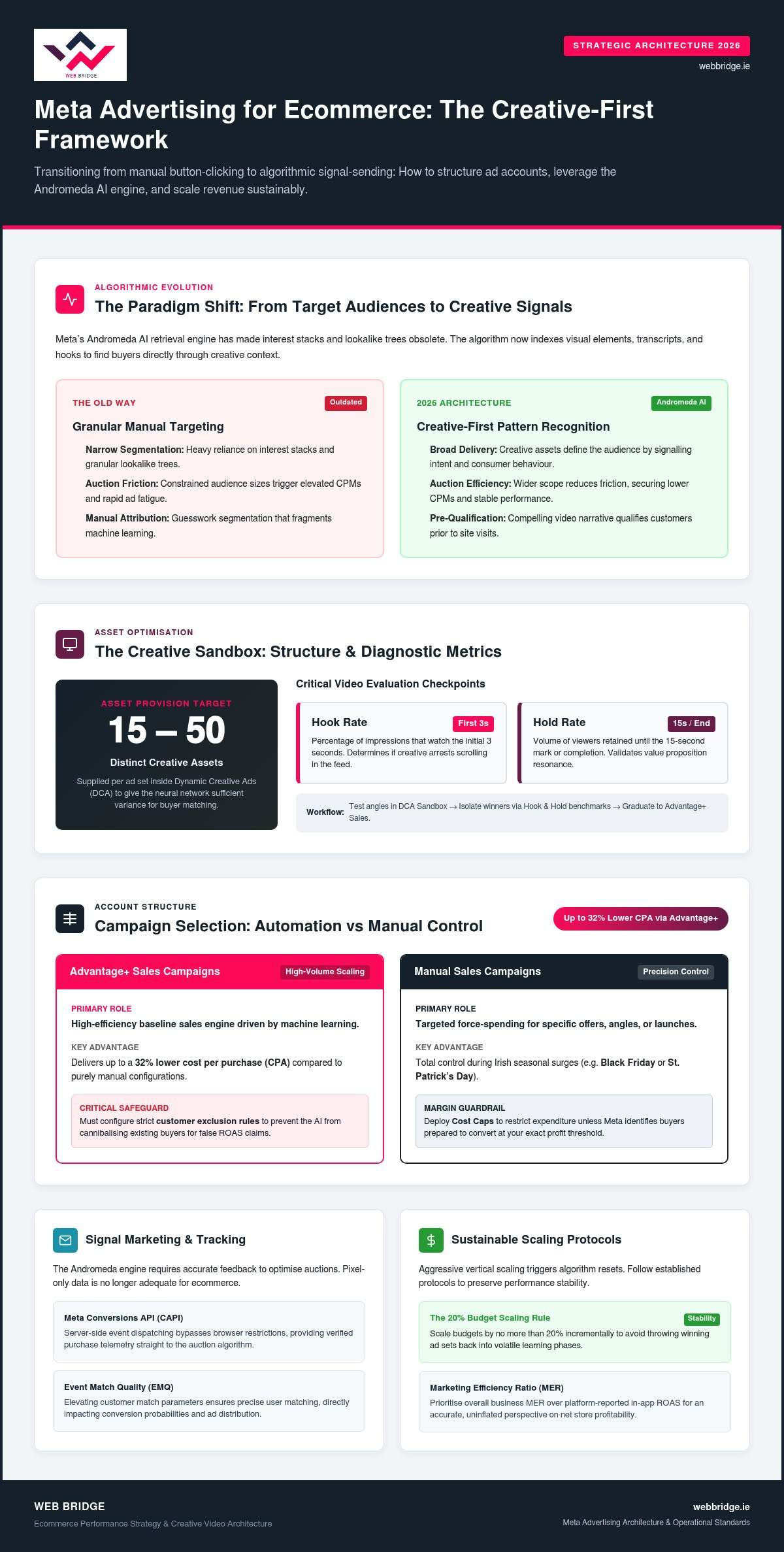
In 2026, your ad account structure needs to reflect a fundamental shift in how social network advertising operates. The Andromeda AI retrieval engine has replaced manual audience building with sophisticated pattern recognition. This means the algorithm no longer relies on you to select interests or demographics; instead, it indexes your creative assets to find the right buyers. For high-growth brands, Meta advertising for ecommerce is now about providing enough “creative signals” for the machine to do its job. Your creative strategy is your targeting strategy.
The Death of Granular Targeting
Restricting Meta with narrow interest stacks or lookalike trees often leads to higher CPMs and limited scale. This is particularly true in the Irish market, where small audience sizes can cause ad fatigue to set in within days. By moving to broad targeting, you allow the algorithm to scan the visual elements, transcript, and hook of your ads to identify potential customers. The creative itself defines the audience. If your ad features a high-end skincare routine, the AI will naturally find users exhibiting skincare-buying behaviours. This approach reduces friction in the auction, leading to lower costs per thousand impressions (CPMs) and more stable performance over time.
Building a Creative Testing Sandbox
Success depends on a dedicated environment for experimentation. Most top-tier advertisers now use a “Creative Sandbox” campaign separate from their main scaling campaigns. This is where you test new hooks and angles using Dynamic Creative Ads (DCA) to see what resonates before moving them to your primary Advantage+ Sales structure. You should aim to supply between 15 and 50 distinct creative assets per ad set to give the neural network sufficient variety for matching. Focus on two critical metrics to identify winners:
- Hook Rate: The percentage of people who watch the first 3 seconds of your video.
- Hold Rate: How many viewers stay until the end or the 15-second mark.
High-quality assets are the foundation of this strategy. Professional video production allows you to craft compelling stories that qualify your customers before they even click. By the time a user lands on your site, the video has already done the heavy lifting of explaining the value proposition. This pre-qualification process is essential for Meta advertising for ecommerce, as it ensures your traffic is ready to convert, directly improving your return on investment.
Choosing Your Campaign Type: Advantage+ vs Manual Setup
Deciding between full automation and manual control is the most significant hurdle when scaling Meta advertising for ecommerce. By 2026, Meta has consolidated its automated offerings under the Advantage+ banner, formally renaming Advantage+ Shopping Campaigns (ASC) to Advantage+ Sales. Whilst the algorithm’s ability to drive results is undeniable, a “one size fits all” approach rarely works for Irish brands balancing growth with tight margins. Success involves knowing when to let the AI take the wheel and when to keep your hands on the gears.
Advantage+ Sales Campaigns
Advantage+ Sales campaigns are designed for high-volume efficiency. They leverage machine learning to automate audience selection and creative delivery, often delivering up to a 32% lower CPA compared to purely manual configurations. For established online stores, this is the primary engine for scaling. However, you must avoid the “set and forget” trap. To ensure true incremental growth, you need to set strict customer exclusion rules within the campaign settings. This prevents the algorithm from simply retargeting your existing fans and claiming credit for sales that would have happened anyway. Understanding signal marketing in Meta ads is vital here; the more high-quality data you feed the system, the better it performs.
Manual Sales Campaigns for Precision
Manual setups remain essential for precision and control, especially during seasonal Irish events. When you’re preparing for Black Friday or a specific St. Patrick’s Day promotion, a manual campaign allows you to force spend behind specific offers or creative angles that the AI might initially overlook. This structure is also ideal for testing new landing pages or product launches where historical data is thin. We recommend using “Cost Caps” within manual campaigns to protect your profit margins. This ensures Meta only spends your budget when it finds customers likely to convert at your target price point. If you’re unsure which setup fits your current growth stage, our team at Web Bridge can help you design a hybrid account structure that balances automated scale with manual precision.
In a post-cookie environment, your campaign structure must account for signal loss. Instead of relying on traditional retargeting ad sets, which have become less effective due to privacy changes, focus on a consolidated structure. Use a single Advantage+ Sales campaign for broad prospecting and a separate manual testing sandbox. This prevents audience fragmentation and allows the algorithm to exit the learning phase faster, which typically requires 50 conversion events per week. By simplifying your setup, you give Meta’s Andromeda engine the room it needs to find your best customers across Ireland and beyond.
How to Set Up Your Technical Foundation for 2026
Scaling Meta advertising for ecommerce in 2026 requires more than just a great video; it demands a robust technical pipeline. Without accurate data, even the best creative will struggle to find its target audience. Browser-only pixels now miss between 30% and 50% of purchase events due to privacy controls and ad blockers. To fix this, you must implement the Meta Conversions API (CAPI) to reclaim lost attribution and provide the algorithm with the signals it needs to optimise your spend.
Conversions API (CAPI) Implementation
The Meta Conversions API (CAPI) acts as a direct, server-side bridge that sends customer behaviour data from your website’s server to Meta’s servers without relying on browser-based cookies. For many Irish SMEs, the easiest way to deploy this is through CAPI Gateway solutions, which offer a one-click setup without needing deep coding knowledge. This server-side tracking is no longer optional; it’s the only way to maintain an Event Match Quality (EMQ) score above 8.0. High EMQ scores allow Meta to match your website visitors to their platform profiles with precision, often recovering 20% to 30% of conversion signals that were previously invisible.
Landing Page Optimisation for Ads
Your website performance is a critical factor in your ad’s relevance score. If your landing page takes more than three seconds to load, your cost per click will soar as users bounce before the pixel even fires. We specialise in ecommerce website development in Ireland to ensure your site is tuned for high-speed performance. Speed matters. When a user clicks an ad in Dublin, they expect a seamless transition to your shop.
A fast, mobile-optimised experience is essential for the modern “Instagram to Checkout” journey. You should also enable Advanced Matching, which sends hashed customer data like email addresses alongside the event signal. It provides Meta’s Andromeda engine with the specific data points required to link a purchase back to a specific ad interaction. Ensure your site handles local nuances like VAT display and Irish regional shipping options clearly; these small details prevent friction at the final stage of the funnel. By building this foundation, you ensure that every Euro spent on Meta advertising for ecommerce is tracked accurately, giving you the data needed to scale your budget with confidence.
Developing High-Converting Ad Creative for Ecommerce
Creative assets are the most powerful lever you have for Meta advertising for ecommerce. In 2026, the algorithm uses your visual content to find your customers, making the “Hook, Body, CTA” framework the foundation of every successful campaign. You need to stop the scroll, build desire, and provide a clear path to purchase within seconds. Whilst automation handles the delivery, your creative must handle the persuasion.
The Anatomy of a Winning Video Ad
The first three seconds of your video determine your success on the Instagram feed. This “hook” must be visually striking or emotionally resonant to capture attention before the user swipes past. Once you’ve stopped the scroll, the body of your ad should demonstrate product value whilst maintaining a high-end brand aesthetic. We use professional Video Production to craft brand stories that feel authentic yet premium. This balance is vital for Irish shoppers who value local trust and professional execution. For your product catalogue, Dynamic Product Ads (DPAs) should be enhanced with custom frames or lifestyle backgrounds to move beyond the basic white-background look and feel like a curated shopping experience.
Direct Response Copywriting
Your copy should act as a silent salesperson that addresses specific local pains. Instead of listing features, write headlines that highlight the primary benefit. For the Irish market, mentioning “Next Day Delivery” or a “Dublin Showroom” can significantly boost conversion rates by removing common friction points. Testing short, punchy copy against longer, story-driven narratives is essential, as different price points require different levels of information. High-ticket items often benefit from longer copy that builds a deeper narrative, whilst impulse purchases thrive on urgency and simplicity.
Utilising User-Generated Content (UGC) is another effective way to build immediate trust. Seeing a real customer in Cork or Galway unboxing your product provides social proof that a studio shoot cannot replicate. However, the synergy between your ad creative and your landing page is where the real magic happens. If your video promises a premium experience, your site must deliver it. If you’re ready to elevate your brand’s visual identity and drive better results, book our video production services to start creating high-converting assets today.
Scaling and Optimising Your Meta Ad Results
Scaling isn’t just about spending more; it’s about spending smarter. You’ve likely seen your performance fluctuate wildly after a sudden budget hike. To maintain stability, follow the 20% rule: never increase your daily spend by more than 20% every 48 to 72 hours. This prevents the algorithm from re-entering the learning phase and spiking your CPA. In 2026, we focus on the Marketing Efficiency Ratio (MER) rather than just platform-reported ROAS. MER gives you the true picture of how Meta advertising for ecommerce impacts your total bottom line by looking at blended revenue across all channels, accounting for the attribution gaps caused by the March 2026 redefinition of link-click windows.
The Scaling Framework
Vertical scaling—simply raising the budget—only works until you hit a performance ceiling. In the Irish market, saturation happens quickly due to the smaller population size. You’ll know an ad is saturated when frequency rises whilst your conversion rate dips. To combat this, use horizontal scaling by launching entirely new creative angles to reach different buyer cohorts. For example, if your “problem-solution” video is tiring, launch a “behind-the-scenes” or “press feature” asset to capture a new segment of users. We also recommend setting automated rules to pause underperforming ads during off-peak hours, ensuring your budget is always directed toward high-intent windows when shoppers are most active.
Holistic Growth Strategies
Meta Ads don’t exist in a vacuum. They create a powerful “Halo Effect” that drives significant volume to your other channels. When a user sees your ad on Instagram, they might not click immediately, but they often search for your brand later on Google. This is why we integrate Meta advertising for ecommerce with Search Engine Optimisation to capture that high-intent search traffic. A total growth strategy ensures you’re visible at every stage of the customer journey. By supporting your social efforts with Google Ads, you create multiple touchpoints that reinforce trust and increase the likelihood of a sale.
Our approach at Web Bridge focuses on this synergy. We understand that a successful funnel requires a seamless transition from a scroll-stopping ad to a high-performance website. By handling both the creative production and the technical tracking, we ensure your data signals remain clear and your ROI stays high. If you’re ready to stop guessing and start growing your online presence, you can enquire about our integrated Meta Ads management today to see how we can scale your online store sustainably.
Future-Proof Your Ecommerce Growth in 2026
Scaling successfully isn’t about outsmarting the machine; it’s about feeding it the right signals. By prioritising high-quality video creative and securing your technical foundation with CAPI, you’ve already moved ahead of the competition. Sustainable growth relies on a stable scaling framework and a holistic view of your marketing efficiency. Meta advertising for ecommerce works best when it’s part of a seamless funnel that connects scroll-stopping content to a high-performance website.
As Dublin-based ecommerce experts, we’ve seen how integrated video and ad management can transform results for Irish SMEs. We focus on the data that matters to ensure your digital presence is both reliable and profitable. You don’t have to navigate these technical hurdles alone. Our team is ready to help you turn these strategies into tangible revenue and lower your cost per purchase for the long term.
Book a Meta Ads Strategy Consultation with Web Bridge to start building your high-performance growth engine. Your online store has the potential to scale; let’s make it happen together.
Frequently Asked Questions
Is Meta advertising still effective for ecommerce in 2026?
Yes, Meta advertising for ecommerce remains a dominant growth engine. Recent data shows DTC brands allocate over 66% of their budgets to the platform. The introduction of the Andromeda AI retrieval engine has made the platform more efficient at finding buyers without manual audience selection. By prioritising high-quality creative over complex targeting, Dublin businesses can reach local and international shoppers more effectively than ever before.
How much should a small ecommerce business spend on Meta ads?
You should start with a budget that allows for 50 conversion events per week to exit the learning phase. Once you find a winning ad, increase your spend by no more than 20% every 48 to 72 hours. This gradual approach keeps your CPA stable. Smaller Irish stores often find success by focusing on a single product launch before scaling their total monthly investment.
What is the difference between a Facebook Pixel and the Conversions API?
The Facebook Pixel is a browser-based tool that often misses up to 50% of purchase data due to ad blockers and privacy settings. The Conversions API (CAPI) is a server-side connection that sends data directly to Meta. Implementing CAPI is essential for maintaining a high Event Match Quality score. It ensures your tracking remains accurate even when browser cookies are blocked by modern smartphones or desktop devices.
How long does it take for Meta ads to start showing results?
You will usually see initial data within 48 to 72 hours, but the algorithm needs seven days to complete the learning phase. Meta requires approximately 50 conversions per ad set during this window to optimise delivery. For Dublin stores, results often improve as the Andromeda engine gathers more creative signals. Avoid making significant changes to your campaigns during this first week to let the machine learning stabilise.
Can I run Meta ads without a large video production budget?
You don’t need a massive budget to succeed, but your content must look professional to build trust. Authentic User-Generated Content (UGC) often outperforms high-budget commercials on the Instagram feed. We provide integrated video production services to help Irish brands create scroll-stopping assets without the stress of managing multiple agencies. Focus on clear storytelling and a strong hook to engage your audience from the first second.
What is a good ROAS for an ecommerce store in Ireland?
A median ROAS of 1.88 is currently the benchmark for ecommerce brands, though this varies by industry. Instead of only looking at platform-reported figures, focus on your Marketing Efficiency Ratio (MER). This measures total revenue against total ad spend. For Dublin businesses, a healthy ROAS should always be balanced against your profit margins and the customer’s lifetime value to ensure sustainable long-term growth.
Should I use Advantage+ Shopping Campaigns for my new store?
Yes, Advantage+ Sales campaigns are highly effective for new stores because they automate the heavy lifting of audience discovery. These campaigns deliver up to a 32% lower CPA compared to manual setups by using machine learning to match your products with interested buyers. It’s a great way for startups to gather data quickly. Just ensure you set up strict customer exclusion rules to focus on acquiring new shoppers.
How do I track my Meta ad sales accurately after the iOS 14.5 update?
Accurate tracking now requires a combination of the Conversions API and Advanced Matching. Since the March 2026 update, Meta has redefined the 7-day click window to strictly require an outbound link click. By passing hashed customer data like emails and phone numbers through CAPI, you can recover up to 30% of lost signals. This technical setup is vital for any Meta advertising for ecommerce strategy in a privacy-first world.