
What if your business didn’t need to post more, but to make each piece of content work harder? A steady stream of disconnected updates can take time without showing what is driving visibility, enquiries or sales. Effective content creation for business Ireland starts with a system that connects each asset to a business goal and gives customers a useful next step.
If you’re unsure which topics and formats deserve attention, or how to create content consistently with limited time, start by focusing on the customers you want to reach, the questions they need answered and the channels that suit your business. For a Dublin business, that may mean answering questions about a service customers are searching for locally, rather than trying to maintain a presence everywhere.
This 2026 guide will help you build a manageable content plan, choose topics and formats for Irish audiences, and connect content with your website, SEO, video and relevant social or paid campaigns. You’ll also learn how to review performance and apply what you find to future content, so every asset has a clear purpose and contributes to your wider growth.
Key Takeaways
- Build content creation for business Ireland around a clear business goal, the customers you want to reach and the questions they’re asking.
- Compare articles, website pages, social content, email and video by the job each needs to do, rather than chasing a supposedly best format.
- Use a repeatable workflow to plan, produce, review and publish content, then adapt strong assets into supporting formats with care.
- Choose channels based on your audience and capacity, and track measures that show whether content is contributing to your priorities.
- Connect discovery to a relevant website destination and next step, using SEO, video or paid campaigns where they support the goal.
What content creation for business in Ireland actually involves
Content creation for business in Ireland means producing useful material for a defined audience to support a specific business goal. It can include website pages, articles, social posts, emails and videos. Content marketing goes further: it brings that material to the right people through distribution, then reviews its performance to inform what to do next.
That distinction matters. Creating a post or article is one task; deciding who needs it, where it should appear and what action it should encourage is part of a wider content marketing process. For a foundational overview, see what content marketing is.
Start with customer needs, not a favourite platform. A channel may be popular, but that doesn’t make it right for every business or message. First identify what people are trying to understand or do. Then choose a format and channel that can meet that need and fit the time, skills and resources you have available. For a Dublin business, consider whether customers are looking for general guidance, a specific service or information relevant to their local area.
What counts as business content?
Content can take many forms, and the best fit depends on its purpose. A local trades business might use a website service page to explain what it does and how customers can enquire. An Irish food producer could share an email with product updates, while a business-to-business consultancy might publish an article answering a common client question. A short video could show a product in use or explain a process.
Choose a format by asking three questions: What does the audience need? What can the business produce consistently? What should the audience do next? A detailed article may suit a complex topic, whilst a concise social post can introduce an idea and direct interested readers to a useful page. Neither format is automatically better; its value depends on the job it needs to do.
How content supports business goals
Useful content can help people discover a business, understand its offer, make an enquiry, complete a purchase or get support after becoming a customer. One asset can contribute to more than one goal, provided its main purpose stays clear. For example, a well-structured service page may answer questions for someone comparing options and make it straightforward to enquire.
Make the intended next step relevant and specific. A reader learning about a service may need a clear route to explore the service page, whilst someone seeking practical guidance may benefit from another helpful resource. Content designed for Irish search intent should use the language customers actually use, rather than relying on assumptions about what they want. For businesses targeting nearby customers, local SEO in Ireland can help useful website content reach people searching for relevant services in their area.
How Irish businesses can plan content around customers and goals
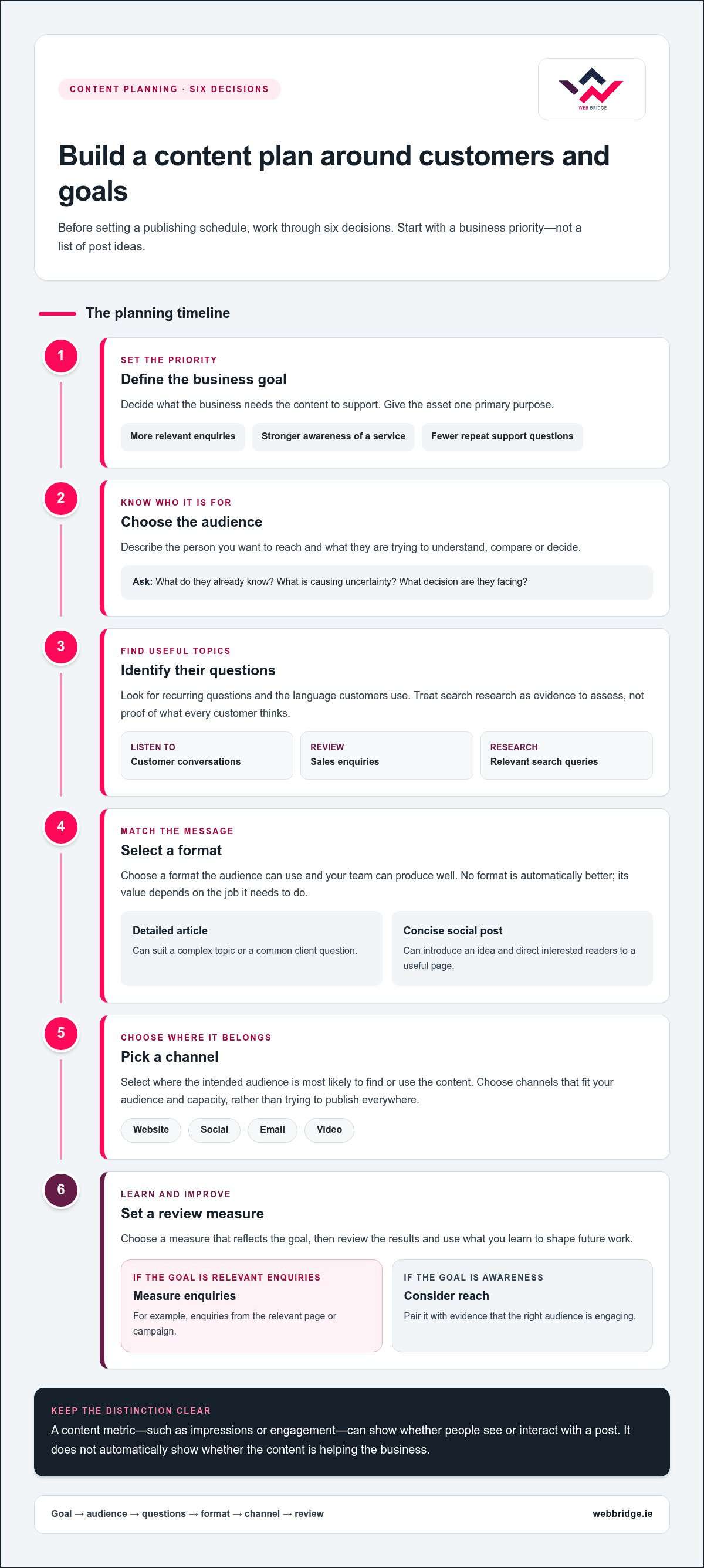
A useful plan starts with a business priority, not a list of post ideas. For content creation for business Ireland, work through six decisions before setting a publishing schedule:
- Define the goal. Decide what the business needs, such as more relevant enquiries, stronger awareness of a service or fewer repeat support questions.
- Choose the audience. Describe the person you want to reach and what they’re trying to understand, compare or decide.
- Identify their questions. Gather recurring questions from customer conversations, sales enquiries and relevant search queries.
- Select a format. Match the topic to a format your audience can use and your team can produce well.
- Pick a channel. Choose where the intended audience is most likely to find or use the content, rather than trying to publish everywhere.
- Set a review measure. Decide how you’ll judge progress, then review results and use what you learn to shape future work.
Choose an audience and a measurable content goal
Keep the business objective separate from the content metric. Impressions and engagement can show whether people are seeing or interacting with a post, but they don’t automatically show whether it’s helping the business. If the objective is to generate relevant enquiries, for example, measure enquiries from the relevant page or campaign. If the goal is awareness, reach may be a useful indicator, alongside evidence that the right audience is engaging.
Be specific about the reader: what do they already know, what’s causing uncertainty, and what decision are they facing? Give each asset one primary purpose. This makes it easier to decide what information belongs in it, what action to invite and which measure is meaningful. A Dublin business could, for instance, focus a service page on the questions potential local customers ask before making an enquiry, then assess whether the page leads to relevant enquiries.
Build a practical content calendar
Use customer questions as a starting point, then check whether people search for those topics and how they phrase their queries. Search results and keyword research can reveal relevant intent, but treat them as evidence to assess, not proof of what every Irish customer thinks. For local topics, compare search language with the locations and services your business genuinely serves. Local SEO in Ireland can support research into how local searches connect customers with relevant business information.
Next, group related ideas into themes, such as service explanations, practical advice or common decision-stage questions. Add seasonal topics only when they matter to your customers or operations. In the calendar, record each asset’s goal, audience, format, channel, owner and realistic publication date. Set a rhythm your available team can sustain. A smaller, well-planned schedule is more useful than a crowded calendar that repeatedly slips.
Use the calendar as a working plan, not a promise to publish regardless of changing priorities. Review it regularly, keep strong ideas in reserve and adjust dates when capacity changes. If local search is part of your plan, Web Bridge’s local SEO approach can support the work of making relevant business information easier to find.
Which content formats and channels suit your Irish business?
There’s no single best format for every Irish business. Choose based on what your audience needs, the action you want them to take and the capacity you have to create and maintain the content. A short social post may introduce an idea, whilst a detailed article can answer a complex question. For content creation for business Ireland, the format and channel should support the goal, not simply follow a trend.
| Format | Suitable goal | Production considerations | Possible distribution channel |
|---|---|---|---|
| Article | Explain a topic or support organic discovery | Needs research, a clear structure and useful detail | Website, search, email |
| Website page | Explain an offer and encourage a relevant next step | Keep information current, clear and easy to act on | Website, search, paid campaigns |
| Short-form social content | Build awareness or prompt interaction | Plan a focused message and adapt it to the platform | LinkedIn, Instagram |
| Share updates with an opted-in audience | Needs a relevant message and a useful reason to read | ||
| Video | Demonstrate, explain or tell a story visually | Consider scripting, filming, editing and where viewers will watch | Website, YouTube, social channels |
When articles, website pages or email make sense
Articles suit questions that need a considered answer, such as explaining how a service works or comparing approaches. They can support organic discovery when they match what people are searching for and provide genuinely useful information. A service page has a different job: make the offer clear, address relevant questions and guide visitors towards an appropriate next step.
Email gives a business a direct way to share useful updates with people who have opted in to receive them. It can point readers to a new article, explain an update or help customers make use of a service. Keep each message focused, and make its value clear to the recipient.
When social content or video is the better fit
Social posts can quickly introduce an idea or offer a concise insight; video can show a process, product or person in action. Professionally produced video may help deliver a polished visual story, while a written guide is often easier to scan for detailed instructions or reference information. Web Bridge provides professional video production for businesses looking to communicate through visual storytelling.
Think of platforms as distinct channels. LinkedIn can suit professional insights and business-to-business topics; Instagram can support visual storytelling and product-led content; YouTube can host demonstrations, explainers and videos people may want to revisit. Choose where your audience is active and where your team can publish consistently. A considered social media channel plan can help align platform choice with content goals and capacity.
How to create, publish and improve content with limited resources
A repeatable workflow helps a small team produce useful content without starting from scratch each time. Keep the process lean, but build in clear ownership and a final quality check. That makes content creation for business Ireland more manageable and helps each asset stay connected to its purpose.
Create a repeatable production workflow
Start with a short brief. Record the audience, purpose, key message, format and call to action, then gather the information needed to create the asset. Give each stage a clear owner: someone to provide subject expertise, someone to draft or produce the content, and someone to edit, approve and publish it. One person can hold more than one role, but responsibility should be clear.
- Brief: Set the audience, goal, key message, format and next step.
- Research: Check facts and gather useful evidence, examples or customer questions.
- Draft or produce: Create the first version in the format chosen for the task.
- Review: Check accuracy, clarity, accessibility and consistency with your brand.
- Publish and distribute: Prepare the asset for its intended destination, then share it through relevant channels.
- Learn: Review performance and note what to test or improve next time.
Before publishing, check that links work, the call to action is clear, and the content is easy to read or use on relevant devices. For example, a substantial guide might become a short social post, an email summary and a video outline. Don’t copy the same wording into every channel. Adapt the message, length and opening so each version makes sense to its audience and gives them a useful reason to engage.
Measure what works and refine the next cycle
Choose a small set of measures that reflect the goal. Reach, impressions and engagement can indicate attention; they’re different from outcomes such as a qualified enquiry, a completed form or another meaningful action. Google Analytics 4 and platform reporting can help assess relevant activity when they’re configured for the task. Keep the measures consistent enough to compare performance over time.
Set a regular review point that suits your publishing rhythm, such as a monthly check for active campaigns or a quarterly review of broader themes. If results are weak, don’t assume the topic itself failed. Check whether it reached the right audience, whether the format suited the message, whether distribution was adequate and whether the destination made the next step clear. Change one element at a time where practical, so you can learn what made a difference.
To connect content with paid promotion, Web Bridge manages Google Ads and Meta Ads campaigns. For guidance on how to plan social content around your channels and workflow, explore this social media channel resource.
Turn business content in Ireland into a connected digital growth plan
Content works harder when it forms part of a clear customer journey. Someone might discover an answer through search or a social post, visit a relevant page on your website, then take a useful next step such as making an enquiry or exploring a service. Each stage should connect: the content sets expectations, the destination delivers on them, and the next action is easy to understand.
Connect content with your website and search visibility
A social post can attract attention, but a relevant website page gives interested visitors somewhere to find fuller information. Make that destination easy to use on mobile, clear about what you offer and focused on the action that matters. Thoughtful web design for business websites can help bring the content, user experience and conversion path together.
SEO supports discoverability by helping search engines understand relevant pages and connect them with suitable searches. It’s a longer-term part of a content plan, not a promise of rankings or immediate results. Optimise pages around the questions and language of your intended audience, provide useful information and make sure each page has a clear purpose. Then check whether visitors can move naturally from discovering your content to finding the service or information they need.
Choose support that matches the next business priority
Build the digital plan around the gap you need to address. If relevant customers struggle to find your business through search, SEO and useful, well-structured content may be the right focus. If a product, process or service is easier to understand visually, video production can support that story, with distribution chosen to suit the audience and goal. If a campaign needs additional reach, Google Ads or Meta Ads can help put relevant content in front of a selected audience. Paid promotion works best when the content and landing page give people a clear, consistent next step.
These activities work together, but they don’t all need to happen at once. A business might first improve a key website page, strengthen its organic visibility, then use a paid campaign to support a specific promotion. Another may prioritise video and social distribution to explain an offer. Web design, SEO, advertising and video are complementary capabilities when they’re selected to solve a defined business need.
For content creation for business Ireland, keep the plan practical: decide what needs to improve, choose the right content and support, and measure whether the customer journey is working. Explore Web Bridge’s digital services to see how a connected approach can support your next business priority.
Make your next content decision count
Strong content creation for business Ireland isn’t about publishing more for the sake of it. It’s about understanding what customers need, choosing formats and channels that suit your goals, and building a manageable process to create, distribute and review each asset.
Give every piece a clear purpose and destination. Useful content can attract attention, guide visitors to a relevant website page and make the next step easier. Review performance against your business priorities, then use what you learn to shape the next cycle.
Web Bridge brings together SEO to improve search visibility and attract organic traffic, web design focused on user experience, Google Ads and Meta Ads management, and professional video production. These capabilities can support a connected digital plan shaped around your business priorities, including for businesses in Dublin looking to improve their online presence.
Explore Web Bridge’s digital services and take the next step towards a more focused content system. With a clear plan and the right support, your content can work harder for your business.
Frequently Asked Questions
What does content creation for a business include?
Content creation for a business means producing useful material for a defined audience and purpose. It can include website pages, articles, social media posts, email content and video. The right mix depends on customer needs, business goals and the resources available to create content consistently. Planning how to distribute each asset and reviewing its results helps you understand whether it’s contributing to wider priorities, such as visibility, enquiries, sales or customer support.
How do I create a content strategy for a small business in Ireland?
Start with a business goal, then decide which customers you want to reach and what they need to know. Collect real questions from enquiries and customer conversations, then research relevant search topics rather than assuming what people want. For a Dublin business, consider whether local terms and the areas you serve matter to your audience. Choose formats your team can sustain, set realistic publication dates and decide how you’ll review progress.
What type of content is best for a business?
There isn’t one best content type for every business. Articles can explain detailed topics, service pages can clarify an offer, email can share useful updates, and video can show a product or process. Choose by audience need, business objective, channel suitability and production capacity. For example, a complex question may need a detailed guide, whilst a concise social post could introduce the topic and direct interested readers to a fuller explanation.
How often should a business publish content?
Publish at a pace your team can maintain without compromising accuracy or usefulness. The right frequency depends on your goals, audience, format and available resources, so there’s no universal schedule. A carefully prepared monthly article or a smaller number of well-planned updates may be more valuable than frequent posts with little substance. Review performance at regular intervals, then adjust the calendar to reflect what’s working and what your team can realistically deliver.
How can I measure whether business content is working?
Measure each asset against its main purpose. Reach, impressions and engagement can indicate attention, whilst relevant website actions, qualified enquiries or sales can show progress towards business outcomes. Use Google Analytics 4 or platform reporting where they’re configured and relevant, and compare patterns over time rather than judging one post alone. If performance is weak, review the topic, format, distribution and destination before deciding what to change.
Can one piece of content be used across different channels?
Yes, one strong core idea can often support several channel-specific assets. A detailed article, for instance, could inform a concise social post or an email summary. Adapt the length, opening, presentation and call to action for each audience and platform. Avoid copying the original unchanged everywhere. Each version should make sense in its context, offer value on its own and guide people towards a relevant next step.
Should a small business create content in-house or get agency support?
The right approach depends on your team’s subject knowledge, time, goals and the work involved. In-house staff can bring close knowledge of customers, whilst specialist support can help with areas such as SEO, web design, advertising or video production. Some businesses combine the two, using internal expertise alongside external support for specific needs. For Dublin businesses, Web Bridge provides web design, SEO, Google Ads and Meta Ads management, and professional video production.