
What if the website is ready to launch, but customers still abandon their baskets? A successful online shop depends on more than polished design: the platform, checkout, delivery and customer experience need to work together.
Choosing where to start can feel like a lot. You need a platform that suits your products and can scale, clear payment and delivery options, and customer information and returns processes that are easy to understand. This practical guide to online store setup Ireland covers those decisions in a clear launch sequence, so you can build a store that’s straightforward to browse and buy from.
We’ll take you from planning your products and choosing a platform through payments, fulfilment and launch checks, then look at ways to measure performance and support future growth. You’ll also see how responsive design, a smooth customer journey and conversion-focused development can help turn a website into a useful sales channel. With a manageable foundation in place, SEO and digital advertising can help more potential customers discover your store.
Key Takeaways
- Set clear goals for your shop before choosing a platform, so decisions support the business you want to build.
- For online store setup Ireland, compare platform capabilities with your catalogue, integrations and plans for growth.
- Make payments, delivery details and customer information clear to build confidence throughout checkout and fulfilment.
- Test your store on desktop and mobile, including navigation, forms and checkout, before launch.
- Use analytics and customer feedback to spot opportunities to improve the buying journey and grow visibility over time.
Before setting up an online store in Ireland, define what success looks like
Attractive product pages are only one part of a confident launch. Your store also needs to serve the right customers, make ordering straightforward and fit the way you can manage stock, dispatch and support. A clear plan helps you avoid choosing tools before you know what the business actually needs.
This guide follows the full setup journey: setting priorities, choosing a platform and building the store foundations, planning payments and fulfilment, testing before launch, then identifying practical first steps for growth. The right online store setup Ireland businesses need depends on their products, customers and capacity, not on adding every feature from day one.
Clarify your offer, audience and first sales goals
Start by describing what you’ll sell, who is most likely to buy it and what need or problem your products address. Be specific: “homewares for people furnishing a first flat” gives you a clearer basis for product descriptions and navigation than “everyone who likes home décor”. Then define where you’ll sell, such as within Ireland initially or across several markets. Your sales territory affects what you’ll need to plan for in delivery, customer information and operations.
Set a small number of measurable launch goals. These might be completed orders, revenue targets you’ve set for your business, or qualified enquiries if customers need advice before buying. Choose a time period for reviewing progress and decide how you’ll measure each goal. A focused opening range can make this easier: launch with products you can describe, price and fulfil reliably, then expand as you learn what customers respond to.
For a sense of the variety of online businesses operating in Ireland, browse the Online retailers of Ireland category. Use it as general market context, not a substitute for deciding what makes your own offer relevant to its intended customers.
Map the customer journey before choosing tools
Trace the customer’s experience from discovery to after-sales support. What information helps them assess a product? What happens after they place an order? Map the steps from payment confirmation to picking, packing, dispatch, delivery updates and help with questions. Assign each responsibility clearly, even if one person handles several stages. This reveals the practical needs your platform and integrations must support.
Next, check your fulfilment capacity. Consider how stock will be recorded, how quickly orders can be prepared, what happens when an item is unavailable and how you’ll handle busy periods. These decisions help you set delivery expectations you can meet, rather than relying on a website promise that doesn’t match day-to-day operations.
Separate must-haves from later enhancements. Secure checkout, usable product information and a workable order process are launch essentials. More advanced automation or expansion into multiple markets may be worthwhile later, but can add complexity before you have evidence they’re needed. This is where ecommerce development should connect store structure, customer experience and conversion goals; explore ecommerce website development in Ireland as one route to a tailored, responsive store. Start with the operation you can run well, then build towards the next stage.
Choose an ecommerce platform and build the essential store foundations
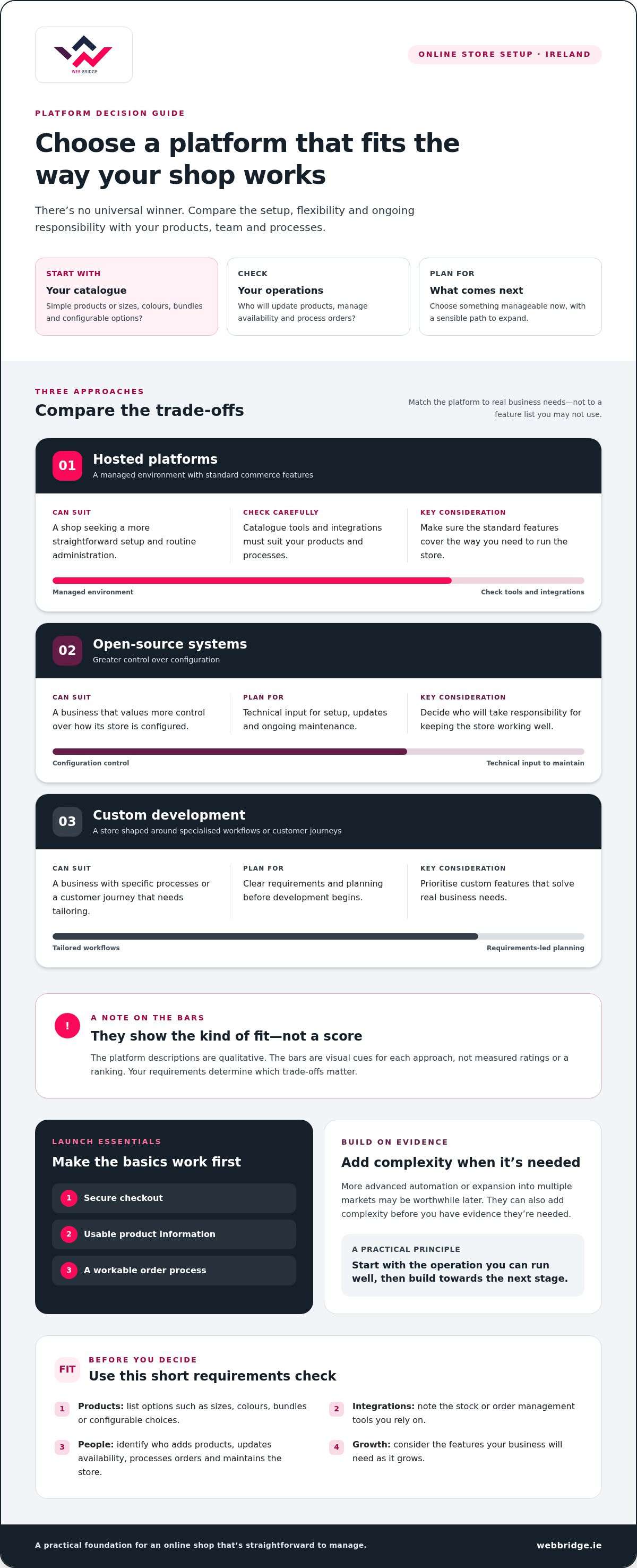
The platform shapes how you manage products, process orders and improve the shop over time. For online store setup Ireland, there’s no universal winner: the right choice depends on your catalogue, the tasks your team can manage and the features your business will need as it grows.
Compare the main approaches against your actual requirements:
- Hosted platforms: Usually offer a managed environment and standard commerce features, which can simplify setup and routine administration. Check that the catalogue tools and integrations suit your products and processes.
- Open-source systems: Offer greater control over configuration, but can require more technical input for setup, updates and maintenance. Consider who will take responsibility for keeping the store working well.
- Custom development: Can be shaped around specialised workflows or customer journeys. It calls for clear requirements and planning, so prioritise the custom features that solve real business needs.
Think beyond the initial build. Who will add products, update availability, process orders and maintain the store? A standard setup may be a practical starting point if your needs are straightforward. More complex product options, integrations or processes may call for greater flexibility. Choose for manageability now, with a sensible path to expand.
Select a platform that fits your products and operations
Match platform capabilities to your catalogue. A shop selling a few simple products has different needs from one with multiple sizes, colours, bundles or configurable options. List the integrations you rely on, such as stock or order management, and make sure the store’s structure supports them. Tailored ecommerce website development can connect the site’s architecture with customer experience and conversion goals.
Design product pages and navigation around customer decisions
Make it easy for customers to find the right item. Use category names they recognise, keep important products within a clear navigation structure, and add search that helps shoppers narrow the selection. Your domain should be easy to recognise and remember; link it consistently to the store and use it across customer communications.
Each product page should answer the questions a customer needs to make a decision. Include an accurate description, clear imagery, available variants, current availability and delivery information. Make return guidance easy to find before checkout, rather than leaving customers to search for it later. Keep product details consistent with what you can supply.
Design for smaller screens from the outset. Check that menus are easy to use, product options can be selected, and forms are simple to complete on a mobile device. A responsive layout helps customers browse and buy comfortably across screen sizes. For a tailored approach that brings these foundations together, explore ecommerce website development in Ireland.
Set up Irish payments, delivery and customer information with care
Checkout is where your store’s promises meet its operations. Customers should be able to see what they’ll pay, understand how delivery works and complete payment without unnecessary friction. In a considered online store setup Ireland businesses can build, these details are part of the customer experience, not tasks to leave until launch week.
Make checkout clear, secure and easy to complete
Offer payment methods suited to your customers and products, using a payment provider that integrates with your store. Keep checkout focused: show delivery charges and expected timings before the customer submits an order, and make each step easy to follow on mobile. Explain the payment process plainly, and use the provider’s intended payment flow rather than handling sensitive card details yourself.
Test the full journey, not just the successful payment screen. Check what happens when a payment succeeds or is declined, whether confirmation messages are accurate, and whether the customer can correct details before submitting. A test order can also reveal gaps between checkout and your order-management process.
Plan Irish delivery, returns and customer data handling
Set out where you deliver, how orders are prepared and dispatched, and how customers will receive updates. Decide who monitors orders, handles tracking queries and contacts customers if a parcel is delayed. Make your returns and refund information, business contact details and relevant terms easy to find before purchase. Clear guidance helps customers understand what to expect and gives your team a consistent way to respond.
Map the order workflow from payment confirmation through picking, dispatch, delivery communication and support. For example, identify who checks stock, who packs the order and how an exception, such as an unavailable item, is handled. An integrated store can connect checkout and these operational steps; ecommerce website development in Ireland can bring the site structure and customer journey together.
Before publishing, verify current requirements with authoritative Irish and EU sources. The standard Irish VAT rate is 23% for most goods and services, but product-specific treatment can vary, so check the applicable rules with Revenue. The Consumer Rights Act 2022 includes online-shopping protections, including a 14-day cooling-off period for eligible purchases. Check current guidance from the Competition and Consumer Protection Commission (CCPC) on consumer information and cancellation processes. For personal data, consult the Data Protection Commission; also verify any accessibility obligations that apply to your store. These checks help keep policies and customer-facing information accurate as rules change.
Prepare your Irish online store for launch with a practical test plan
A launch-ready shop needs more than finished product pages. Work through the checks in order: review content, test store functions, confirm customer-facing policies, place test orders and decide what you’ll monitor once the shop is live. A structured final review helps catch small issues before they disrupt a customer’s first purchase.
Run end-to-end checks before opening the store
Start with the main buying journey. Choose a product, select any available variant, add it to the basket, change quantities and complete a test payment. Check the order confirmation, customer email and stock records, then follow the order through your fulfilment steps. Test the refund process too, so you understand what customers and your team will experience if an order needs to be cancelled or refunded.
Review each key page for accurate details, working links and clear contact, delivery and returns information. Then test the store on desktop and mobile. Use this checklist:
- Display: Do pages and product details fit the screen without awkward scrolling or cut-off content?
- Navigation: Can customers find categories, products and important information?
- Forms: Do contact and checkout fields accept information and show helpful error messages?
- Checkout: Can shoppers select products, update the basket and complete payment successfully?
- Accessibility basics: Is text readable, are controls easy to identify, and can the key actions be used with a keyboard?
Check page performance on the devices your customers are likely to use. Fix problems that slow browsing or block an order before adding optional features. Keep a record of test results and assign someone to resolve each issue.
Plan the first weeks of store operations
Before launch, name who owns incoming orders, customer questions, stock changes and delivery exceptions. Make sure the person responsible knows how to spot failed payments, respond to customer messages and update availability when stock changes. Clear ownership keeps operational tasks from falling between the cracks.
After launch, monitor visits, product engagement, checkout completion and customer feedback. Look for patterns: customers may view a product without adding it to the basket, or start checkout but not complete it. Use feedback and observed friction to prioritise improvements with a clear customer or business benefit, rather than adding features by default.
Ongoing technical care can help keep the store functioning as content and business needs change. Explore website repair and maintenance in Ireland to support your store’s upkeep.
Grow an Irish online store with better visibility and a stronger customer experience
Launching your shop is the start of learning, not the finish line. Customers need to discover your products, trust the information they find and move through a buying journey that works smoothly. Growth comes from improving these parts together, guided by what shoppers actually do rather than assumptions about what the store needs.
Build visibility through search and relevant marketing
Help customers find the right products with useful category and product content. Use the words shoppers use to describe their needs, answer common questions clearly and make each page’s purpose easy to understand. A sound website structure supports this work, whilst responsive design helps keep the experience consistent across devices. Paid campaigns can extend your reach, but first make sure product pages, checkout and measurement are ready to turn visits into meaningful outcomes.
Turn customer and sales data into focused improvements
Review search queries, product engagement, checkout exits and customer support themes. If shoppers repeatedly ask about a product detail, improve its page; if they leave during checkout, investigate where the process becomes unclear. Use customer feedback alongside store analytics to identify the issue, then make one meaningful change at a time and compare results against a defined goal.
Keep the review practical. Track measures that relate to your launch goals, such as completed orders or qualified product enquiries. Look for useful patterns over time rather than reacting to every short-term fluctuation. This creates a manageable improvement cycle: identify friction, make a considered change, then assess whether the customer journey is clearer.
For organic discovery, build relevant content around the products and questions your customers search for, and strengthen category pages as your understanding of search behaviour develops. Paid activity can complement this foundation once measurement is in place. The right mix depends on your products, audience and capacity to fulfil demand.
Web Bridge’s ecommerce development brings responsive design, user experience and conversion goals into the same store plan. If you’re planning a new shop or want to improve an existing one, explore ecommerce website development as a practical next step. A tailored foundation can make it easier to refine the buying journey as your business grows.
Start with one improvement your customers will notice, then measure its effect. Consistent, evidence-led changes can help your Irish online store build visibility and make buying easier over time.
Build a store that’s ready to grow
A strong online shop starts with clear goals, a platform that fits your products and operations, and a customer journey that makes browsing and buying straightforward. Careful checks before launch help catch issues early, whilst analytics and customer feedback show where to focus next.
Keep growth manageable. Improve product content, checkout and visibility in response to what customers do, rather than adding features without a clear purpose. A considered online store setup Ireland businesses can build on connects the store’s foundations with ongoing improvement.
Web Bridge provides ecommerce website design and development, bringing responsive design, user experience and conversion optimisation into the planning process. If you’re ready to shape your next steps, plan your ecommerce website with Web Bridge.
Start with a clear plan and build from there. A well-organised store gives your business a practical foundation for reaching customers and growing with confidence.
Frequently Asked Questions
How do I set up an online store in Ireland?
Start by defining what you’ll sell, who you want to reach and how you’ll fulfil orders. Then choose a platform that fits your products and day-to-day operations, organise the domain, categories and product pages, and set up payments, delivery information and customer policies. Before launch, test a complete order on desktop and mobile. This step-by-step approach to online store setup Ireland gives you a practical foundation to improve as customer feedback comes in.
Do I need to register a business to sell online in Ireland?
Your registration steps depend on your business structure and trading name. A company must be incorporated with the Companies Registration Office (CRO), whilst a sole trader has different tax-registration responsibilities with Revenue. If you trade under a business name other than your own name, business-name registration may also apply. Selling online doesn’t remove these responsibilities. Check current CRO and Revenue guidance, or get advice suited to your circumstances before trading.
What is the best platform for an online store in Ireland?
The best platform is the one that fits your catalogue, product options, integrations and ability to manage the shop. Hosted platforms can simplify routine administration; open-source systems can offer more control but may need additional technical upkeep. Custom development can suit specialised workflows. Compare how each option handles products, orders and future changes, as well as who will maintain it. There isn’t one platform that is right for every Irish retailer.
Can I accept card payments on an Irish online store?
Yes. You can accept card payments by integrating a payment provider with your ecommerce checkout. Choose an option that suits your customers and store requirements, and make charges and payment steps clear before customers place an order. Test successful and declined transactions, confirmation messages, refunds and mobile checkout. Use the provider’s intended payment flow, and avoid handling sensitive card details directly unless you have the appropriate systems and expertise.
How do I handle delivery and returns for an Irish online shop?
Set clear delivery areas, charges and estimated timings, then define how orders move from payment confirmation to dispatch and customer updates. Tell shoppers how to contact you about delays, returns or refunds, and make this information easy to find before purchase. Under Ireland’s Consumer Rights Act 2022, online shoppers generally have a 14-day cooling-off period for eligible purchases, subject to exceptions. Check current CCPC guidance when preparing your returns information.
Do I need to charge VAT when selling online in Ireland?
VAT registration depends on your taxable turnover, the goods or services you sell and where your customers are. For businesses selling goods, the Irish VAT registration threshold is €85,000 in annual turnover; different rules and thresholds can apply to services and cross-border sales. Ireland’s standard VAT rate is 23% for most goods and services, though some have different treatment. Check your position and current rates with Revenue or a tax professional.
How can I get more customers to an online store in Ireland?
Build visibility with useful product and category content that reflects what customers search for, then improve pages and checkout using analytics and customer feedback. For a Dublin business, local SEO can support discovery by nearby shoppers, whilst Google Ads or Meta Ads can extend reach when your store and measurement are ready. Web Bridge provides SEO and digital advertising alongside ecommerce development, helping businesses connect visibility with a smooth buying experience.