
For a Dublin business targeting customers in Cork, effective content creation cork can start with fewer, more purposeful pieces rather than a higher posting frequency. The practical choice is whether to create content in-house, work with a freelancer or bring in an agency, based on your goals, expertise and workflow. You’ll also need to decide which formats will help you reach the people you want to connect with.
A blog article, short video and social post each play a different role. None can deliver its full value without a clear purpose and a plan for distribution. Good content answers a real audience need and reaches people on the channels they use.
This guide compares the main approaches to content creation, helps you match formats to your goals and resources, and explains how to plan for Cork audiences while keeping your business’s Dublin location and service details clear. You’ll also learn how video, SEO and paid distribution can work together, and which measures can show whether content is contributing to engagement, enquiries and sales.
Key Takeaways
- Set a business outcome first, then choose content that supports it.
- Compare video, social posts, search-led articles and website content by purpose and channel.
- Weigh in-house, freelance and agency workflows against your needs for expertise, coordination and continuity.
- Make content for Cork audiences useful by grounding it in real customer questions and accurate local details.
- Connect production with SEO, web design and paid distribution, then measure outcomes that matter.
What Does Content Creation in Dublin Mean for Your Business?
Content creation is the process of planning and producing useful material for a defined audience and business goal, then publishing and reviewing it as part of your wider marketing activity. It can include articles, website pages, social posts and video. Each piece needs a purpose, a route to its audience and a way to assess its usefulness.
That distinction matters. A video or article made without a clear audience, channel or next step may contribute less than a carefully planned piece that answers a customer’s question. A sound Content marketing strategy connects relevant material with an audience and a business objective. For a Dublin business creating content for local or Cork audiences, start by deciding what the content needs to do, not how often to publish.
Which business goals can content creation support?
Different goals call for different content. Educational articles can answer customer questions and support relevant organic visibility through search. Video can introduce a service, show how a process works or make an offer easier to understand. Campaign content, such as a focused social post or landing page, can build awareness, encourage engagement or invite enquiries. These are possible roles, not guaranteed outcomes. The message, audience and distribution all matter.
Choose the format to suit the task. If you need to explain an option in detail, an article or website page may be more useful than a short social post. If a service is easier to understand when seen, video could be a better starting point. More content isn’t automatically better. Relevance and a clear purpose matter more than volume.
Why should Dublin businesses consider local audience needs?
Local relevance starts with the people and places your business actually serves. A Dublin business targeting Cork customers should distinguish its location from the audience it wants to reach, and make any relevant service-area details clear. For a business serving several areas, explain which locations are included when that helps potential customers assess whether the offer is relevant to them.
Use genuine customer questions and your business context to shape topics. Explain how a service works, what a customer needs to know before enquiring, or which areas the business serves. Avoid adding place names just to make a page seem local. Thoughtful content planning for Dublin or Cork audiences is more useful than generic references to a city or county.
Which Content Formats Work Best for Cork Businesses?
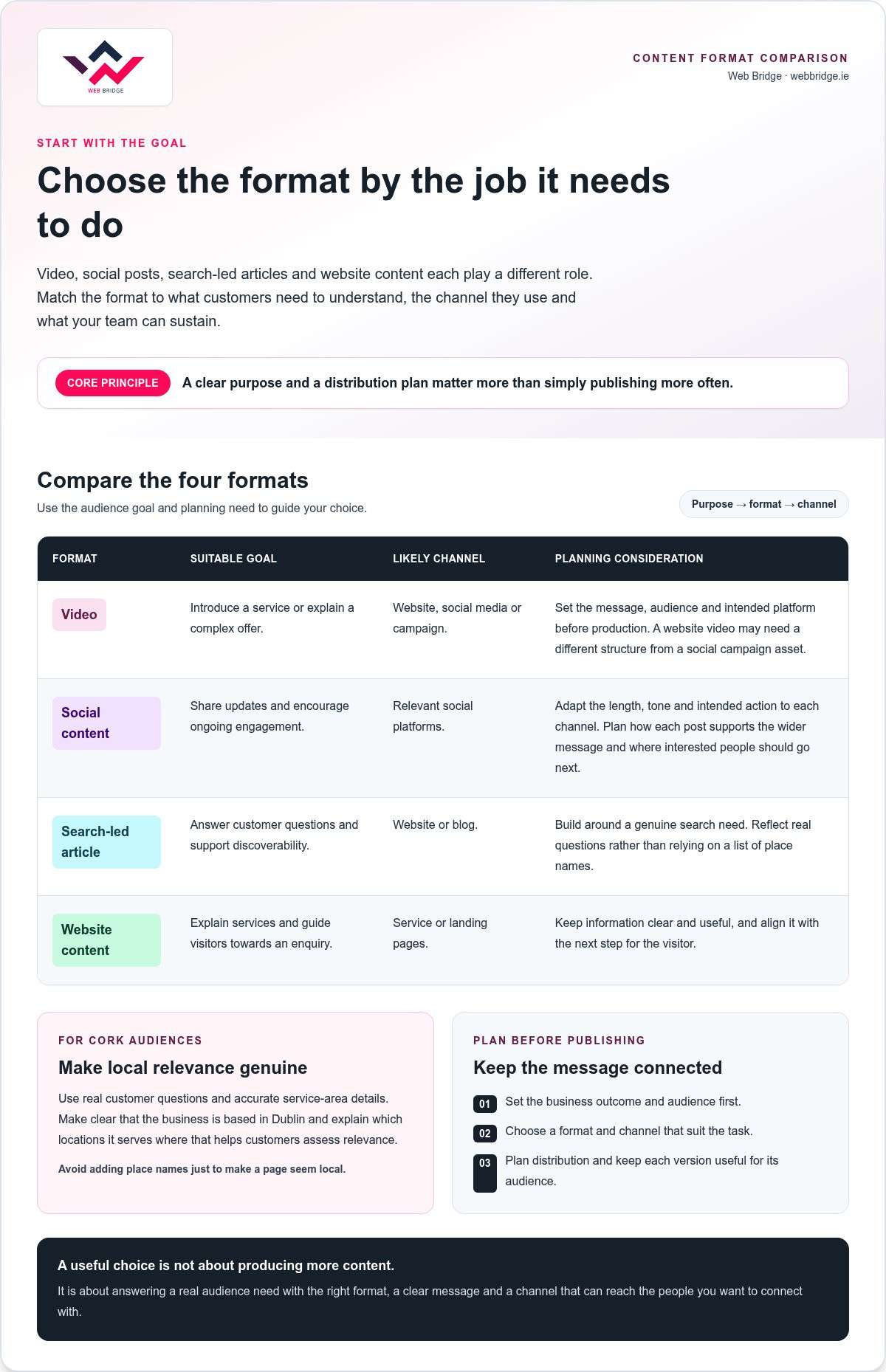
There’s no single best format for every business. The right choice depends on what you want customers to understand or do, where they’re likely to encounter your message, and what your team can sustain over time. A search-led article can answer a detailed question, while a social post can share a timely update. Start with the goal, then choose a format and distribution channel to match.
Content marketing works best as a considered strategic marketing approach, rather than a collection of unrelated assets. You can adapt one useful topic for several channels, as long as the core message stays consistent and each version suits its audience.
| Format | Suitable goal | Likely channel | Planning consideration |
|---|---|---|---|
| Video | Introduce a service or explain a complex offer | Website, social media or campaign | Set the message, audience and intended platform before production. |
| Social content | Share updates and encourage ongoing engagement | Relevant social platforms | Adapt the length, tone and call to action to each channel. |
| Search-led article | Answer customer questions and support discoverability | Website or blog | Build around a genuine search need, not a list of place names. |
| Website content | Explain services and guide visitors towards an enquiry | Service or landing pages | Make the information clear, useful and aligned with the next step. |
When is video production a useful content choice?
Video can bring a service to life, introduce the people or ideas behind a brand, or explain an offer that’s difficult to communicate in a few lines. A useful brief identifies the intended audience, the main message and where the video will appear. A video for a website may need a different structure from a campaign asset for social media. Web Bridge provides professional video production as part of a wider digital marketing offer.
When should a business prioritise search or social content?
Prioritise search-focused content when customers are looking for answers, services or information your business can provide. Useful pages should reflect those questions and make your offer easy to understand. If you’re targeting Cork, explain relevant service details accurately rather than repeating “Cork” throughout the copy.
Social content suits messages that benefit from regular, channel-specific communication, such as updates, short explanations or campaign material. Plan how each post supports the wider message and where interested people should go next. For content creation cork, match the format to the audience and objective, and include distribution in the plan from the outset.
In-House, Freelancer or Agency: Which Content Creation Approach Fits?
The right setup depends on the work your business needs and how closely content must connect with the rest of your marketing. In-house teams, freelancers and agencies can all contribute. In every case, production should serve a defined business outcome, rather than treating a finished asset as the end of the process.
What are the trade-offs between in-house and freelance content creation?
An in-house team often knows your brand, customers and internal processes well. That can make it easier to gather information and coordinate content with other teams. The trade-off is that specialist skills and capacity depend on the people available internally.
A freelancer can bring focused expertise to a defined project, such as writing an article or creating a video. This can suit a business with a clear brief and someone in-house to manage approvals and publishing. Plan how the freelancer’s work will fit the wider content strategy.
Whichever route you choose, set clear ownership. Decide who supplies business information, approves drafts, schedules publication and reviews performance. Without those responsibilities, even strong work can stall before it reaches its audience.
When can an agency approach suit a Cork business?
An agency can be useful when several parts of your marketing need to work together. A website page, search visibility, video and paid distribution can support one objective when the message and customer journey align. For example, a campaign may need a relevant landing page as well as content to reach its intended audience. The right mix depends on the goal, audience and distribution plan.
For content creation cork, consider whether your team has the time and expertise to coordinate each stage, or whether joined-up support would make the workflow clearer. Web Bridge’s services include web design, SEO, Google Ads, Meta Ads and professional video production, which can contribute to connected digital activity. When social distribution is part of the plan, social media marketing services can support the wider campaign.
Paid distribution can put campaign content in front of a chosen audience, while organic search helps people find relevant information. Neither replaces a clear message or useful destination. Before deciding how to distribute content, outline what the audience should learn or do next.
Choose the model that fits your resources and coordination needs. A business with established internal capacity may keep creation in-house, while a defined specialist project can suit freelance support. When planning, production and distribution overlap, an agency-led workflow can bring those elements together around the business objective.
How to Brief and Measure Content Creation for Cork Audiences
A useful brief makes content creation cork more focused. It gives everyone a shared understanding of who the content is for, what it should achieve and how you’ll judge its value. Use this sequence before drafting or production begins.
- Define the goal. Decide whether the priority is organic visibility, engagement, enquiries or another business objective.
- Name the audience. Be specific about the customers you want to reach. Distinguish Cork City from a wider County Cork audience where that affects the message.
- Set the key message. Identify what the audience needs to understand, using real customer questions and your business context. Include local details only when they clarify relevance, not as decorative keywords.
- Choose the format. Match the content to its purpose, whether that’s a search-led article, service page, social post or video.
- Plan the channel and next step. State where the content will appear and what you want the audience to do or learn afterwards.
- Agree how you’ll review it. Choose relevant indicators before publishing, and decide who will review them and act on the findings.
What should a content brief include?
Alongside the goal, audience, message, format and channel, include your brand voice, factual references and any required call to action. Name the person responsible for approval and clarify who will publish the finished piece. These details help keep content accurate and prevent avoidable delays.
For search-led retailer content, connect product and category information to questions customers are likely to ask. A clear brief keeps the material useful to readers while supporting its search purpose.
How can a business assess whether content is working?
Choose a small set of indicators that reflects the original goal. For an article intended to improve discoverability, review relevant organic visibility and visits. For social content, consider engagement and whether people take the intended next step. If the objective is enquiries, track enquiry actions rather than relying on likes alone.
Keep visibility and engagement signals distinct from conversion actions. A post can attract attention without generating enquiries, while a service page may receive fewer visits but help interested customers take action. Review the evidence in context, then refine future topics, formats or distribution. The aim is to learn what serves your audience, not to assume every piece will perform in the same way.
Web Bridge’s digital marketing services connect content planning with the channels and business goals that matter to your organisation.
How Web Bridge Connects Content Creation with Digital Growth
Content works harder when planning, production and distribution support the same business objective. Web Bridge brings together professional video production, SEO, Google Ads, Meta Ads and web design. The right combination depends on your audience, goal and intended channels. A Cork-focused campaign from a Dublin business may need a different plan from one centred on search visibility or a local Dublin audience.
How can content production connect with search and advertising?
Start by defining the outcome. Then shape the message and choose a format that suits how your audience will encounter it. Video can introduce a brand or provide a campaign asset. SEO can align website content with relevant searches, while paid advertising can distribute a campaign when it suits the objective. A well-planned web page gives interested visitors a clear place to learn more or take the next step.
These elements work best when coordinated. Campaign content should lead to a relevant destination, and that page should continue the same message rather than leaving visitors to work out what to do next. Professional video production can form one part of a wider content and distribution plan.
A practical workflow keeps the project connected from start to finish:
- Define: Set the business objective and identify the audience you want to reach.
- Create: Choose the format and develop content around a clear, relevant message.
- Publish: Select suitable channels and make sure each one supports the intended audience journey.
- Review: Measure activity against the original objective and use what you learn to inform future content.
This gives each asset a role beyond simply being published. It also provides a basis for practical decisions about future formats, channels and messaging. The aim is a connected digital growth plan, not activity for its own sake.
What should Cork businesses do next?
Write down your priority audience, the business goal you want to support and the outcome you want your content to contribute to. Bring your existing channels, current content or main marketing challenge into the project discussion. That gives the conversation a clear starting point and focuses the plan on what matters to your business.
If you’re considering content creation cork as part of a broader digital growth plan, discuss your digital growth goals with Web Bridge.
Build a Content Plan That Moves Your Business Forward
Effective content creation cork starts with a clear business goal, then matches the format and distribution plan to the people you want to reach. Whether you choose in-house expertise, freelance support or an agency workflow, give each piece a purpose and a plan for review.
Use real customer questions and accurate Cork service-area details to keep content useful. Measure what matters to its goal, from search visibility and engagement to enquiries, and use those insights to refine future work.
Web Bridge is an Ireland-based digital marketing and web design agency. Its services bring professional video production together with SEO, advertising and web design, helping businesses connect content with relevant channels and the customer journey around it.
Ready to shape your next step? Discuss your content and digital growth goals with Web Bridge and turn your priorities into a focused plan.
Frequently Asked Questions
What does content creation include for a business?
Content creation includes planning, producing, publishing and reviewing material designed for an audience and business goal. The format depends on the task: a service page can explain an offer, an article can answer a customer question, and a video can demonstrate how something works. A social post can share a timely update. Plan how each piece will reach its audience and how you’ll assess its usefulness after publication.
How do I choose a content creation agency in Cork?
Choose an agency by assessing whether its approach connects your business goal with relevant expertise, production, distribution and measurement. Discuss the audience you want to reach, the formats involved, who manages approvals and how performance will be reviewed. If your business also serves Dublin, make sure local messaging reflects the distinct areas and customers you want to reach. A clear workflow matters as much as the finished content.
Is it better to hire a freelancer or an agency for content creation?
The best fit depends on the scope of work and how much coordination your team can manage. A freelancer may suit a defined project requiring a particular skill, especially when you have a clear brief and someone to handle approvals and publishing. An agency can be useful when several capabilities or channels need to work together. In either case, agree on ownership, continuity and how the work supports your objective.
What types of content can help a Cork business reach local customers?
Search-led website content can answer relevant customer questions and help people discover your services. Video can introduce an offer or explain how it works, while social content can share updates in a format suited to each platform. For content creation cork, use genuine audience questions and accurate service-area details to shape the message. Choose formats based on where your customers look for information and what they need to know.
How often should a business publish new content?
Publish at a frequency your team can sustain without compromising usefulness, accuracy or quality. The right schedule depends on your goals, available resources and chosen channels. A business maintaining a search-led website may plan updates differently from one sharing regular social posts or campaign content. Set a realistic rhythm, allow time to distribute each piece, and review whether the schedule is helping you serve your audience effectively.
How can I measure whether content creation is working?
Measure content against the objective you set before publishing. For visibility, review relevant organic search activity. For engagement, look at how people interact with content. For enquiries, track actions that indicate interest, such as submitted forms or calls. Keep these signals distinct, since attention alone doesn’t demonstrate business impact. Use the findings to adjust future topics, formats or distribution without assuming every piece will produce the same outcome.
Can video content support SEO and social media marketing?
Yes, video can support both when planned for the audience, message and channel. On social media, a concise video may introduce a service or communicate a campaign idea. On a website, video can help explain an offer alongside useful written information. Publishing video doesn’t automatically improve search rankings. Align the page with relevant audience needs and plan how people will find and use the content.