
Could a website maintenance plan keep your site running but leave a broken contact form, checkout or other issue outside its scope? For Irish businesses comparing website developers Dublin providers, the task list matters, but so does knowing what happens when something goes wrong.
It’s understandable to feel unsure about what routine maintenance covers. Updates, backups and security checks may feature in a package, but providers differ on what’s included, what costs extra and how they respond. If a technical fault interrupts enquiries or sales, those details matter.
This guide explains what website maintenance can involve and how to compare support with your website’s complexity and business priorities. You’ll learn what to ask about responsibilities, exclusions, response commitments and urgent issues before choosing a provider. Web Bridge provides web design and ecommerce development. If you’re comparing maintenance support, start by identifying what your business needs and confirming exactly what a provider will deliver.
Key Takeaways
- Learn how ongoing maintenance differs from one-off repairs and a full redesign, so you can identify the right type of support.
- Compare website developers Dublin providers by checking responsibilities, exclusions, communication and documented response targets.
- Use practical questions about your platform, access, backup recovery and urgent faults to clarify how support would work.
- Match a maintenance arrangement to your website’s complexity and the business impact of downtime, rather than choosing by a generic task list.
- Review the available information about website repair and maintenance, then confirm specific deliverables and support terms before deciding whether a provider is a fit.
What do website maintenance services in Ireland cover?
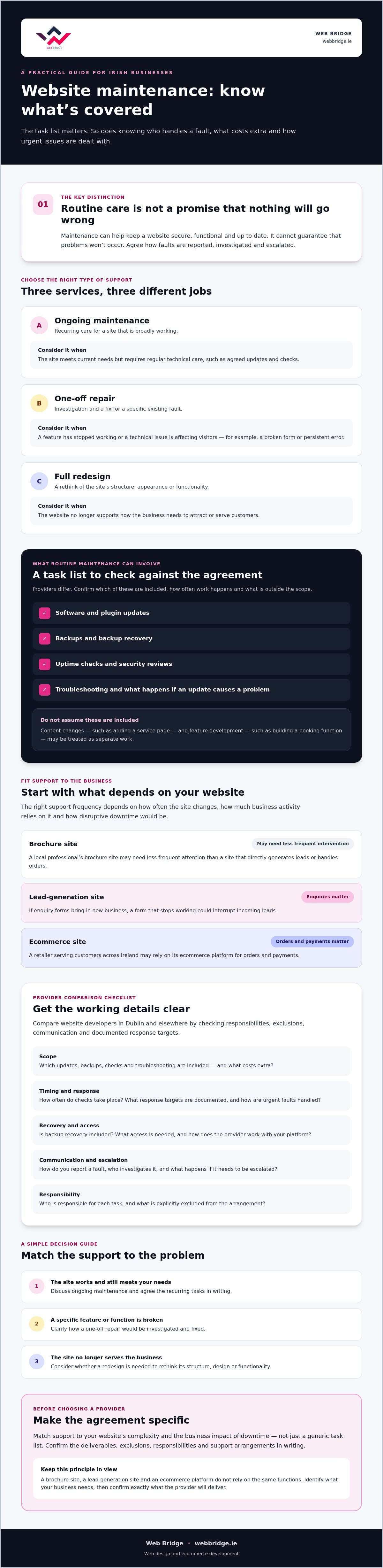
Website maintenance is the ongoing work of keeping a website’s software current, checking that key functions operate and addressing technical issues as they arise. It differs from a one-off website design project, which creates or refreshes a site, and a repair, which fixes an existing fault.
In plain English, website maintenance is regular care that helps keep a website secure, functional and up to date. The work can include preventive checks as well as improvements or corrective fixes. These categories align with the broader concept of software maintenance, but the exact tasks depend on the provider and agreement.
What tasks are normally included in website maintenance?
Routine software and plugin updates help keep a site compatible and address known issues. They’re different from content changes, such as adding a new service page, and feature development, such as building a booking function. Confirm whether either is included or treated as separate work.
Ask providers whether their scope covers backups, uptime checks, security reviews and troubleshooting. Clarify how often checks take place, whether backup recovery is included, and what happens if an update causes a problem. Get inclusions and exclusions in writing rather than assuming every plan covers the same tasks.
Which Irish businesses benefit from ongoing website support?
A brochure site for a local professional may need less frequent intervention than a lead-generation site whose enquiry forms bring in new business. For a Dublin service company, a form that stops working could interrupt incoming leads. A retailer serving customers across Ireland may rely on its ecommerce platform for orders and payments.
That doesn’t mean every business needs the same support frequency. Consider how often the site changes, how much revenue or customer activity depends on it, and how disruptive downtime would be. Use those priorities to discuss suitable checks and support with website developers Dublin providers.
Reliable maintenance can help keep important pages and functions working as intended, supporting a smoother visitor experience and continuity for enquiries or online orders. It can’t guarantee that problems won’t occur, so ask how faults are reported, investigated and escalated. Web Bridge provides web design and ecommerce development. If you’re considering a maintenance provider, review the details on its website repair and maintenance page and confirm the specific tasks, exclusions and support arrangements directly.
How do maintenance, repairs and redesign differ for an Irish business?
These services solve different problems. Maintenance is recurring care for a site that’s broadly working; a repair addresses a fault that already exists; a redesign rethinks the site’s structure, appearance or functionality. Choosing the right route helps you avoid treating a one-off issue as a reason to rebuild, or expecting routine upkeep to fix deeper usability problems.
| Type of support | What it does | Consider it when |
|---|---|---|
| Ongoing maintenance | Applies agreed routine updates and checks to help keep the existing site working. | The site meets current needs but requires regular technical care. |
| One-off repair | Investigates and fixes a specific fault, such as a broken form or persistent error. | A feature has stopped working or a technical issue is affecting visitors. |
| Full redesign | Reworks the website’s structure, design or functionality. | The site no longer supports how the business needs to attract or serve customers. |
When is ongoing maintenance enough?
Maintenance may be suitable when your site still presents the business well and its core functions work, but its software needs regular attention. A provider might agree to recurring updates and checks, with the precise scope set out in writing. This is different from rebuilding pages or changing the site’s underlying structure.
Routine care can support reliability, but it won’t automatically resolve confusing navigation, weak calls to action or a layout that doesn’t suit your customers. For small businesses in Dublin or elsewhere in Ireland, weigh the site’s role in generating enquiries or sales when deciding how much support to arrange. Cybersecurity is also part of the decision: the Cybersecurity guidance for businesses from CISA outlines security practices for small organisations.
When should a business consider repair or redesign?
Start with diagnosis if visitors encounter repeated errors, an enquiry form won’t submit or an essential page fails to load. Those are reasons to investigate a repair, not proof that the whole site needs replacing. Ask a provider to identify the fault and explain whether a targeted fix is appropriate.
Consider a redesign assessment if the problems are broader. For example, customers may struggle to find key information across the site, or its structure may no longer reflect the services you offer. That calls for a longer-term decision about content, layout and functionality, separate from resolving an urgent fault. Website developers Dublin businesses approach should be able to explain which problem they’re addressing and why. If you’re assessing support for an existing site, review the information on website repair and maintenance and confirm the provider’s scope before proceeding.
How can you compare website maintenance providers in Ireland?
A useful comparison goes beyond the number of tasks listed in a package. Check how each provider’s scope, communication and escalation process match the risks your website creates for the business. Choose support according to the business risk of downtime, not a generic checklist of tasks.
Ask website developers Dublin businesses are considering to explain their terms in writing. Compare providers against these points:
- Scope: Which software updates, backups, monitoring and troubleshooting are included? Are content changes, development work or recovery after a failed update excluded?
- Communication: How do you report an issue, who responds and how will you receive progress updates?
- Response and escalation: What response targets and support hours apply? What is the process for faults that affect enquiries or sales? Ask the provider to confirm these commitments rather than relying on informal assurances.
- Documentation and access: Will you receive records of completed work? Confirm who controls website accounts, hosting and other access credentials.
- Continuity: What happens to access, records and ongoing support if the agreement ends?
What should a maintenance agreement explain?
The agreement should define what the provider will do, what counts as extra work and how requests are prioritised. Clarify whether backups are checked and whether restoring them is included, not just creating them. Agree how urgent issues are escalated, how progress is communicated and what reporting you’ll receive. Before signing, make sure your business retains appropriate access to its website and key accounts, and understand the handover process if you change providers.
How should you assess support for an ecommerce website?
An online shop can depend on several connected services. Ask how the provider will approach faults involving product pages, checkout, payment processing, shipping settings or third-party integrations. Confirm whether the provider supports each platform and integration, and whether troubleshooting those services is included or must be handled by another supplier. A checkout issue may need a different escalation route from a minor content error, so ask for clear examples of how requests are prioritised.
If you’re reviewing how an online shop is built or how its components fit together, explore ecommerce website development in Ireland for relevant development context. Then compare proposed maintenance support with your actual platform, integrations and order processes. The more business-critical those connections are, the more important it is to establish responsibility and escalation in advance.
What questions should you ask before choosing website maintenance?
A focused conversation with potential website developers Dublin businesses are considering can reveal whether their support fits the site and the way your team relies on it. Prepare a short brief, then ask for answers in writing. This makes it easier to compare what’s promised, what’s excluded and what happens if a problem affects an important business function.
What information should you prepare before requesting support?
Before speaking with a provider, note your website platform, hosting arrangements, key integrations and any recurring issues. Identify the forms, sales journeys or pages that are most important to keep available. Share access only through a secure process agreed with the provider. Don’t send passwords in ordinary messages or include sensitive credentials in your brief.
Questions to ask before you agree
- What platform and components will you support? Confirm which content management system, themes, plugins and integrations fall within the agreed scope.
- What tasks are included? Ask about updates, backups, monitoring and troubleshooting, as well as any exclusions or work that requires separate approval.
- How are backups recovered? Find out how often backups are made, where they’re held, who can restore them and whether recovery work is included.
- How do I report a fault? Ask how requests are submitted, prioritised and tracked, and who will communicate progress.
- What happens if an urgent issue affects leads or sales? Request the written response target, support hours and escalation process. Check whether these commitments cover investigation, a fix, or both.
- Who controls the accounts and website assets? Confirm who has administrator access and control of hosting, domain-related accounts, backups and website files, and how access is handed over if the arrangement ends.
- How are access and data handled? Ask how the provider manages information they may encounter while working on the site. Verify any claims about relevant Irish and EU obligations against current, authoritative guidance or advice from a qualified professional.
Keep the answers with the proposed scope and agreement. Clear wording matters: a response target isn’t automatically a resolution time, and a backup isn’t useful unless you understand how recovery works. If the provider’s explanations are vague, ask for specific examples before committing.
You can review its website repair and maintenance information and confirm the exact inclusions, exclusions and response arrangements directly before deciding whether the service suits your needs.
How can Web Bridge support website maintenance in Ireland?
Web Bridge provides web design and ecommerce website development. The right maintenance support depends on what your website does, how complex it is and what a fault could mean for your business. A brochure site, a lead-generation website and an online shop may each need a different support approach.
Before choosing a provider, ask for an assessment of your current site and a clear written scope. Confirm the specific maintenance tasks, exclusions, support hours, response arrangements and escalation process rather than assuming they’re included. This helps you judge whether the proposed support matches your priorities, without relying on broad promises.
What should you share when discussing maintenance support?
Give Web Bridge a practical picture of how the site works and where support may be needed. Prepare:
- The website’s purpose, platform and key integrations.
- Known faults, recurring issues or components you’re concerned about.
- Important user journeys, such as submitting an enquiry or completing an online order.
- The business impact if a key page or function becomes unavailable.
With this context, you can ask which tasks are covered, what would be treated as additional work, and how support requests are handled. Request clear written details about response arrangements and exclusions, too. These specifics help you compare a proposal with the actual needs of your site.
When is it time to speak with a website support provider?
Recurring faults, outdated components or uncertainty about who controls website access are good reasons to speak with a provider. So is a change in how the business relies on the site, such as adding online sales or making enquiry forms central to lead generation. Website developers Dublin businesses speak with should understand the current setup before recommending an approach.
A provider should first establish what’s working, what’s causing concern and which functions matter most. That assessment can help distinguish routine maintenance from a repair or a larger development need. Web Bridge’s web design and ecommerce development services may be relevant if you’re planning a new site or changes to an online shop. Confirm directly whether the support you need is available and what it includes.
Ready to outline your platform, current issues and business priorities? Discuss your website project with Web Bridge and ask what approach may suit your site.
Choose support that keeps your business moving
The right maintenance arrangement depends on what your website does and how much the business relies on it. Separate routine upkeep from one-off repairs and redesign work, then compare providers on written scope, exclusions, communication and response arrangements. Asking website developers Dublin businesses are considering clear questions about access, backups and urgent faults can help you choose support with fewer surprises.
Before agreeing to maintenance support, confirm which tasks are included and how the provider’s approach fits your platform, essential user journeys and business priorities. A clear conversation is a practical first step towards a website that remains current and supports your day-to-day goals.
Discuss your website project with Web Bridge and explore what approach may suit your business. Share your website goals and requirements to start the conversation.
Frequently Asked Questions
What do website maintenance services usually include?
Website maintenance commonly includes routine software or plugin updates, backups, security checks, uptime monitoring and troubleshooting. The exact scope depends on the provider and agreement, so ask what is included and what counts as extra work. Content edits and new features may not be part of routine technical care. Request a written breakdown, including how backups are handled and what support is available if an update causes a problem.
How often should a business website be maintained?
There isn’t one suitable maintenance schedule for every business website. Frequency depends on factors such as the platform, how often components need updating, how often the site changes and how important it is to sales or enquiries. Agree a schedule with your provider and confirm how they’ll handle important updates or faults between planned checks. An ecommerce site may need closer attention to key functions than a simple site with static information.
Is website maintenance the same as website repair?
No. Maintenance is ongoing care intended to keep a working website updated and to identify potential issues. Repair is targeted work to diagnose or fix a fault that already exists, such as a form that no longer submits. A site might need both: a repair to restore a faulty function, followed by agreed maintenance. If problems point to wider structural or usability issues, ask whether a separate redesign assessment makes sense.
Can I maintain my business website myself?
Yes, you may be able to manage straightforward tasks yourself, such as updating text or images through your website’s content editor. Technical updates, backups and troubleshooting can require platform knowledge and careful checks, especially if the site supports important enquiries or sales. Before making changes, understand how to recover the site if something goes wrong and keep appropriate account access. You can also ask a provider to clarify which tasks need specialist support.
How do I choose a website maintenance company in Ireland?
Compare providers by written scope, platform experience, communication process and escalation arrangements. Ask what updates, backups and troubleshooting are included, along with support hours, response targets, exclusions and account ownership. Verify commitments directly rather than relying on general claims. Businesses comparing website developers Dublin providers should also explain how the site supports their goals, so they can assess whether the proposed support fits its complexity and the impact of downtime.
Does ecommerce website maintenance include checkout and payment support?
Not necessarily. Checkout troubleshooting may be included by some providers and excluded by others, while payment processing can also depend on an external provider or platform. Ask who investigates issues with checkout, payment integrations, shipping settings and other third-party services, and who handles escalation when a fault sits outside the maintenance scope. Confirm these responsibilities in writing, and ask how the provider checks essential purchase steps after relevant changes.