
Relying solely on paid acquisition to fuel retail growth is a fast track to vanishing profit margins. When rising ad costs bite into every transaction, developing a scalable ecommerce SEO strategy is the single most effective way to secure predictable, compounding revenue. Yet, managing dynamic inventory often feels like an uphill battle against your own platform.
Every time product lines rotate or seasonal items sell out, orphaned URLs, crawl bloat, and broken redirect chains quietly sabotage your visibility. You watch high-volume category pages struggle to outrank retail giants whilst your technical architecture squanders crawl budget on duplicate facets and dead filters.
It doesn’t have to be this way. You’ll discover how to transform catalogue taxonomy into an automated revenue engine, resolve index bloat, and systematically optimise your most profitable product lines. This guide delivers a clear, step-by-step roadmap to help you outmanoeuvre competitors, protect your margins, and scale organic store traffic with confidence.
Key Takeaways
- Build a resilient ecommerce SEO strategy that shields retail margins from rising ad spend by converting commercial intent into predictable organic revenue.
- Establish an intuitive catalogue hierarchy and shallow three-click crawl depth to ensure search engines discover and index every inventory tier seamlessly.
- Separate targeting priorities between high-intent category hubs and conversion-focused product pages to capture head-term volume alongside lucrative long-tail searches.
- Eliminate crawl waste and devastating index bloat by implementing a structured four-step framework to manage dynamic faceted navigation parameters.
- Strengthen technical store architecture with targeted digital PR and product seeding workflows that earn authoritative editorial backlinks.
What Is an Ecommerce SEO Strategy and Why Paid Ads Are Not Enough
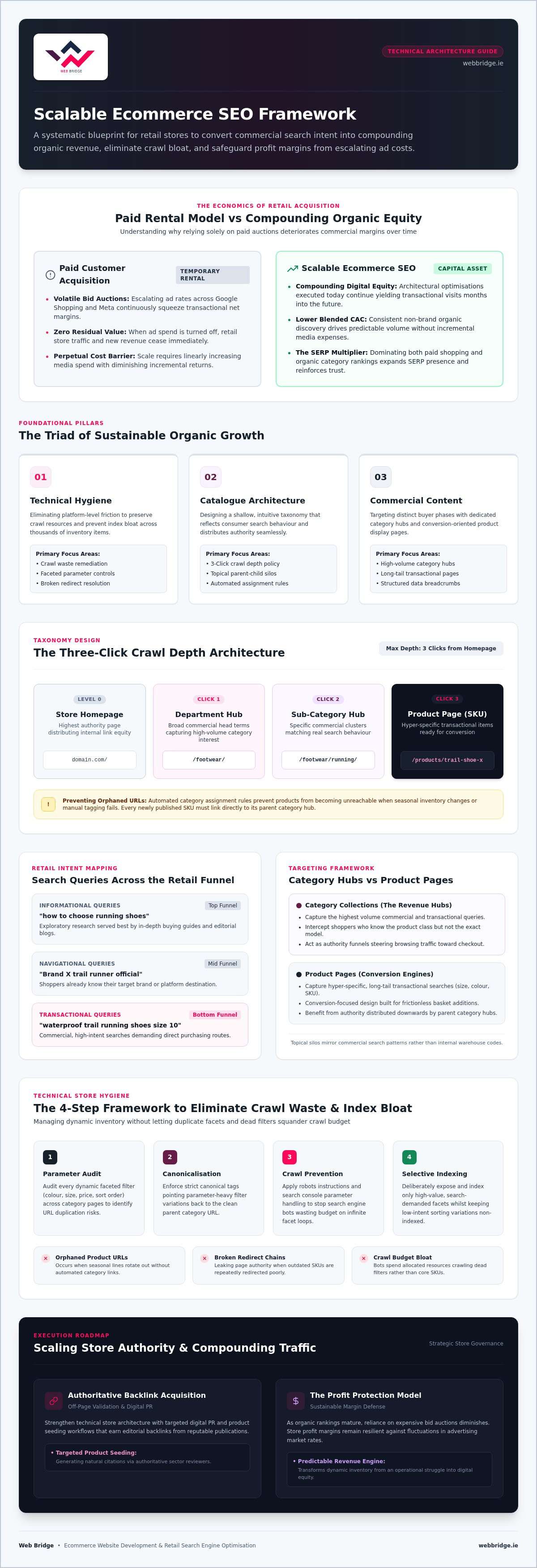
An effective ecommerce SEO strategy is the systematic optimisation of an online store’s technical architecture, category taxonomy, and product pages to capture high-intent commercial searches. Retail search engine optimisation focuses directly on converting non-brand visibility into revenue. Relying solely on paid customer acquisition leaves commercial retailers vulnerable to volatile bid auctions and shrinking margins. When paid campaigns pause, traffic stops instantly. By contrast, embedding sound principles of Search engine optimization (SEO) into your platform builds compounding digital equity and brand trust. A scalable approach balances three core pillars: rigorous technical hygiene, logical catalogue architecture, and targeted commercial content.
The Economics of Organic Traffic vs Paid Search
Rising ad rates across Google Shopping and Meta platforms directly squeeze operating margins. While paid ads deliver instantaneous traffic, they operate as a temporary rental model. Organic search works as a capital investment: optimisation completed today continues driving sales months down the line without incremental media spend. This compounding effect systematically lowers blended customer acquisition costs. Furthermore, running organic optimisation alongside managed campaigns with a Google Ads agency in Ireland creates a profitable multiplier. Dominating both organic category listings and paid shopping placements expands total SERP ownership, reinforcing buyer confidence and lifting total conversions across channels.
Understanding Modern Search Intent Across the Retail Funnel
Modern shoppers rarely travel in a straight line from search bar to checkout. Aligning your digital catalogue with buyer intent requires categorising customer search queries across three distinct retail phases:
- Informational queries: Exploratory searches like “how to choose running shoes” that sit best on buying guides and editorial blogs.
- Navigational queries: Brand or specific model searches where shoppers already know their destination.
- Transactional queries: Commercial, high-intent searches such as “waterproof trail running shoes size 10” that demand immediate purchasing paths.
Whilst product pages serve hyper-specific, long-tail transactional searches, category hubs capture the highest value commercial volume. Optimised category collections intercept shoppers who know what class of product they want but haven’t committed to a specific brand or model. Structuring these hubs effectively allows stores to capture high-volume transactional demand and steer customers effortlessly toward checkout.
Site Architecture and Taxonomy: Designing Category Hubs That Rank
Many retail websites struggle in organic search because they treat search engine optimisation like an editorial blogging exercise rather than a catalogue architecture discipline. A high-performing ecommerce SEO strategy starts with logical taxonomy. Search engines require clean, predictable paths to discover and evaluate thousands of stock keeping units (SKUs) without squandering crawl budget. Enforcing a strict three-click rule ensures that every product sits no more than three clicks away from the homepage. As outlined in Semrush’s comprehensive ecommerce SEO guide, sound structural organisation signals topical authority and clarifies how granular sub-collections support broader department hubs.
Structuring Scalable Category Hierarchies
Parent-child category relationships must mirror actual commercial search patterns rather than internal warehouse codes. Grouping products logically (such as moving from Footwear to Running Shoes, and finally to Trail Running Shoes) creates clear topical silos that match how buyers search. Rapidly changing inventory can lead to orphaned product URLs if manual tagging slips. Building your store on bespoke ecommerce website development architecture resolves this risk by automating category assignment rules, ensuring every newly published SKU immediately links to its parent hub.
Internal Linking Strategies for Product Catalogues
Internal links distribute authority throughout your catalogue, turning high-traffic pages into discovery funnels for deeper inventory. Implementing breadcrumb navigation backed by structured `BreadcrumbList` schema markup establishes clean contextual hierarchy for search engines whilst offering clear paths for shoppers. Maximise your internal link equity by focusing on three practical tactics:
- Lateral category linking: Cross-link complementary subcategories within collection intro copy (for example, linking running socks directly from the trail shoe hub).
- Strategic equity distribution: Use automated “bestseller” and “frequently bought together” modules to channel equity from established revenue drivers to newly introduced lines.
- Thematic bundle merchandising: Feature related accessory collections directly beneath main product specifications to encourage multi-item purchases and deeper crawling.
Systematically connecting your inventory prevents crawl isolation and keeps high-margin products visible. If your expanding inventory is testing the limits of your platform, re-architecting your store through targeted ecommerce website development will ensure your structural framework actively supports long-term commercial growth.
On-Page Optimisation Framework: Product Pages vs Category Hubs
A fatal mistake in retail SEO is applying identical on-page tactics across every URL. Category hubs and individual stock keeping units (SKUs) perform distinct commercial duties within a robust ecommerce SEO strategy. Category pages target high-volume head terms representing broad consumer intent. Individual product pages target hyper-specific, long-tail transactional searches. Copying manufacturer product descriptions straight into your catalogue triggers duplication filters and leaves your pages indistinguishable from thousands of competitors.
| Page Type | Keyword Target | Primary User Intent | Core On-Page Priority |
|---|---|---|---|
| Category Hub | Broad commercial head terms (e.g. “trail running shoes”) | Comparison, filtering, and range browsing | Intro summary copy, structured facet links, subcategory navigation |
| Product Page | Granular long-tail queries (e.g. “men’s waterproof trail shoe size 10”) | Immediate purchasing and checkout | Unique specification copy, genuine customer reviews, Product schema |
Crafting High-Converting Category Page Content
Place a concise, 50-to-80-word introductory paragraph directly above the product grid. This introduces primary semantic keywords without pushing visual inventory below the fold. To capture conversational searches, place an expandable FAQ block beneath the product listings. This keeps the page helpful for shoppers while satisfying search algorithms targeting secondary commercial phrases.
Optimising Product Pages for Long-Tail and Conversions
Ditch generic supplier blurbs entirely. Craft bespoke product copy detailing precise materials, sizing nuances, and practical applications. Enforce unique H1 tags and custom title tags incorporating attributes like brand, colour, and model. Implement comprehensive `Product` and `Offer` schema markup to display real-time pricing and stock status directly within search snippets. Integrating genuine customer reviews satisfies quality guidelines while injecting valuable, user-generated long-tail terms straight onto the page.
Image Optimisation and Visual Search Readiness
Bulky image files quickly ruin mobile page performance. Convert all catalogue imagery into modern WebP formats to maintain high visual clarity with minimal file sizes. Write concise alt text detailing exact visual characteristics to improve accessibility and capture image search traffic. Pairing high-resolution stills with professional video production keeps shoppers engaged longer, showcasing product demonstrations that decrease bounce rates and lift conversions.
Technical Ecommerce SEO: Eliminating Crawl Waste and Index Bloat
Faceted navigation is the single largest driver of crawl bloat on retail sites. When shoppers filter by size, colour, price, or brand, ecommerce platforms dynamically generate millions of parameterised URL combinations. Search engine bots quickly become trapped crawling thin, duplicate filter states instead of discovering your commercial collections. A technically sound ecommerce SEO strategy eliminates this waste, safeguarding crawl budget so search engines index your primary revenue pages without friction.
Managing Faceted Navigation and Parameterised URLs
Controlling dynamic parameters requires a disciplined four-step protocol:
- Audit search demand: Identify specific facet combinations with proven commercial search volume (such as “black running shoes”) and build them as static, indexable landing pages.
- Implement canonical tags: Point parameterised sorting and multi-filter URLs back to the root category page to consolidate ranking equity.
- Deploy robots instructions: Apply
noindex, followtags to low-value facet combinations to keep them out of search indices while letting search bots discover nested products. - Refine crawl directives: Use robots.txt disallow rules cautiously to block infinite filtering loops, ensuring critical CSS, JavaScript, and image files remain completely accessible.
Pagination and Out-of-Stock Inventory Protocols
Pagination must guide crawlers smoothly through multi-page categories without creating index bloat. Use clean, sequential URLs (like /category?page=2) paired with self-referencing canonical tags rather than canonicalising all pages back to page one. Managing sold-out products requires equal care. When a line is permanently discontinued, implement a direct 301 redirect to the closest equivalent subcategory. For temporarily out-of-stock items, keep the URL live, retain its ranking equity, and provide clear back-in-stock email notifications.
Core Web Vitals and Technical Site Maintenance
Slow page responses destroy mobile conversion rates and suppress search rankings. Audit Cumulative Layout Shift (CLS) by reserving explicit dimensional containers for dynamic product banners and sizing widgets. Tackle Interaction to Next Paint (INP) by deferring unneeded third-party tracking scripts that freeze browser responsiveness during mobile checkout interactions.
Keeping an expansive online store technically sound demands constant vigilance. Schedule website maintenance audits and support expectations with Web Bridge’s website maintenance services to resolve crawl bottlenecks, repair broken redirect chains, and keep your retail platform operating at peak efficiency.
Building Authority and Scaling Organic Revenue: Your Execution Roadmap
Flawless site structure and clean indexing establish your store’s foundation, but backlink authority determines who claims top positions. Search engines weigh third-party validation heavily when ranking commercial queries. A truly scalable ecommerce SEO strategy pairs clean catalogue architecture with proactive digital authority building. Earning editorial endorsements signals trustworthiness, lifting the ranking ceiling for competitive product collections and high-margin categories across your entire domain.
Earning High-Impact Backlinks for Retail Brands
Traditional guest posting rarely moves the needle for retail stores. Modern link building demands genuine commercial appeal. First, publish original proprietary data studies analyzing consumer purchasing patterns or emerging sector trends, which naturally earn editorial citations from journalists. Second, reclaim unlinked brand mentions across product review blogs, local press, and supplier directories. Third, establish targeted product gifting initiatives with respected niche creators to earn genuine editorial reviews containing contextual links pointing directly to your category collections.
Building Supporting Content That Funnels Buyers to Categories
Informational content should never exist in a silo; it must actively drive retail transactions. Develop detailed comparison guides, size selectors, and troubleshooting articles that address common pre-purchase questions. These educational hubs naturally attract external backlinks and social shares that product pages struggle to earn organically.
Channel this accumulated authority straight into your product catalogue by embedding contextual internal links pointing toward target category hubs. For merchants operating physical branches alongside their digital storefronts, partnering with specialists in local SEO ensures regional search intent connects smoothly with nearby stock availability and local click-and-collect services.
Measuring Real Commercial Impact and Revenue Metrics
Traffic vanity metrics hide real commercial performance. Sustainable retail growth relies on tracking metrics directly tied to the bottom line:
- Organic transactions and revenue: Measure direct sales generated through organic landing pages via web analytics.
- Organic average order value (AOV): Monitor whether organic shoppers purchase higher-margin bundles or multi-item carts.
- Commercial ranking distribution: Track keyword movements across primary transactional category clusters rather than vanity informational queries.
- Assisted conversions: Evaluate how organic touchpoints nurture customers who later complete transactions through other channels.
Treating technical optimisation, catalogue architecture, and authority building as an integrated discipline transforms search into your most dependable growth channel. If you’re ready to secure sustainable organic visibility and build an automated acquisition engine, explore how you can accelerate your store growth with Web Bridge.
Transform Your Store Catalogue into a Predictable Revenue Engine
Escalating ad auctions make sustainable organic visibility essential for safeguarding retail margins. Achieving market leadership doesn’t come from treating search as a passive checklist. It demands aligning category taxonomy with commercial intent, eliminating crawl waste across faceted navigation, and earning high-impact editorial links. Executed with technical precision, a disciplined ecommerce SEO strategy turns your dynamic inventory into an automated commercial engine that compounds sales month after month.
Bridging the gap between complex catalogue architecture and measurable revenue is where Web Bridge excels. Backed by bespoke ecommerce development and web design expertise, full-stack technical SEO capabilities, and proven integration with Google Ads and paid social, we support ambitious Irish and international retailers in dominating competitive search results. Grow your online store revenue with Web Bridge and build a resilient acquisition model that outpaces your competitors for years to come.
Frequently Asked Questions
How long does an ecommerce SEO strategy take to produce measurable revenue?
Most retailers begin seeing measurable revenue gains within three to six months of implementing an ecommerce SEO strategy. Early commercial wins often stem from resolving technical crawl errors, updating category metadata, and reclaiming broken links. Substantial revenue growth typically compounds between six and twelve months as domain authority builds. For competitive Dublin retailers and international brands, timelines depend heavily on existing catalog authority and historical site health.
How do I handle SEO for products that frequently go out of stock?
Never delete temporarily out-of-stock product pages or redirect them immediately to your homepage. Keep the original URL live with standard status codes to retain accumulated search equity and commercial rankings. Clearly mark the item as out of stock, provide an email notification option, and suggest relevant in-stock alternatives. If a product is permanently retired, implement a direct 301 redirect to its closest parent category hub instead.
What is the best way to handle faceted navigation without hurting SEO?
The best approach combines canonical tags with targeted robots instructions to prevent dynamic filters from squandering crawl budget. Point parameterised sorting and multi-select URLs back to the clean category URL using canonical tags. Apply noindex, follow directives to thin filter combinations so search bots continue discovering nested products. Only build dedicated, indexable static pages for high-demand attribute pairings that possess verified search volume.
Should I write unique descriptions for every single product variant?
No, you shouldn’t write separate descriptions for minor product variants like colour or size options. Creating distinct URLs for minor changes leads to internal keyword cannibalisation and thins your crawl equity across identical copy. Instead, consolidate simple variations onto a single canonical product URL using interactive option selectors. Only build unique, dedicated URLs when specific variants reflect distinct shopper demand with proven search volume.
How does site speed directly impact ecommerce search rankings and sales?
Site speed directly influences Google search rankings whilst heavily dictating shopping cart conversion rates. Search engines actively penalise slow response times and poor visual stability on mobile devices. If an online store takes longer than three seconds to load, bounce rates multiply and buyers abandon carts. Fast page rendering ensures frictionless navigation from category filters to final payment, lifting organic sales for retailers across Dublin and global markets.
Can blog articles really drive sales for an online retail store?
Yes, educational blog articles drive substantial sales when tailored to resolve customer pre-purchase dilemmas. Informative buying guides, sizing advice, and product comparisons engage consumers during early consideration stages. By embedding direct commercial links and featured product cards within your editorial copy, you guide readers straight from informational queries into transactional category collections, turning general research traffic into measurable revenue.
Why do category pages usually rank better than individual product pages?
Category pages rank better for broad commercial terms because they match high-volume browsing intent. Shoppers searching for general merchandise want variety and product comparisons rather than a single pre-selected SKU. An integrated ecommerce SEO strategy treats category hubs as primary landing assets because they naturally attract stronger internal link equity from main menus, passing ranking authority down into individual product lines.