Did you know that whilst mobile devices now drive 65% of landing page traffic, they convert at barely half the rate of desktop computers? It’s incredibly frustrating to watch your hard-earned budget disappear into expensive clicks that never actually become customers. You’ve likely felt the sting of a high cost-per-acquisition while your ad creative and website design seem to be speaking two different languages. Mastering landing page design for ads is no longer just about aesthetics; it’s about building a precise conversion engine that honours the promise of your marketing.
We understand that you want a digital presence that works as hard as you do. We promise to reveal the essential design elements that turn those costly clicks into loyal customers and high-value leads. This article provides a clear framework for 2026, covering everything from message match and mobile optimisation to the technical signals that boost your Google Ads Quality Score and improve your overall ROI. You’ll learn how to align your creative strategy with technical execution to ensure every penny of your marketing spend delivers a tangible result.
Key Takeaways
- Learn why removing navigation menus and distractions is the first step to preventing ad budget waste and reducing user friction.
- Discover the 10-point checklist for landing page design for ads that captures user attention and communicates value in under three seconds.
- Master the “scent trail” technique to ensure your landing page perfectly mirrors your ad creative and builds immediate trust with every visitor.
- Optimise for the Irish market by prioritising mobile-first speed and accessibility to significantly boost your Google Ads Quality Score.
- Understand how integrating professional video and data-driven A/B testing turns standard pages into high-performance conversion engines.
Why Standard Web Design Fails Your Paid Ad Campaigns
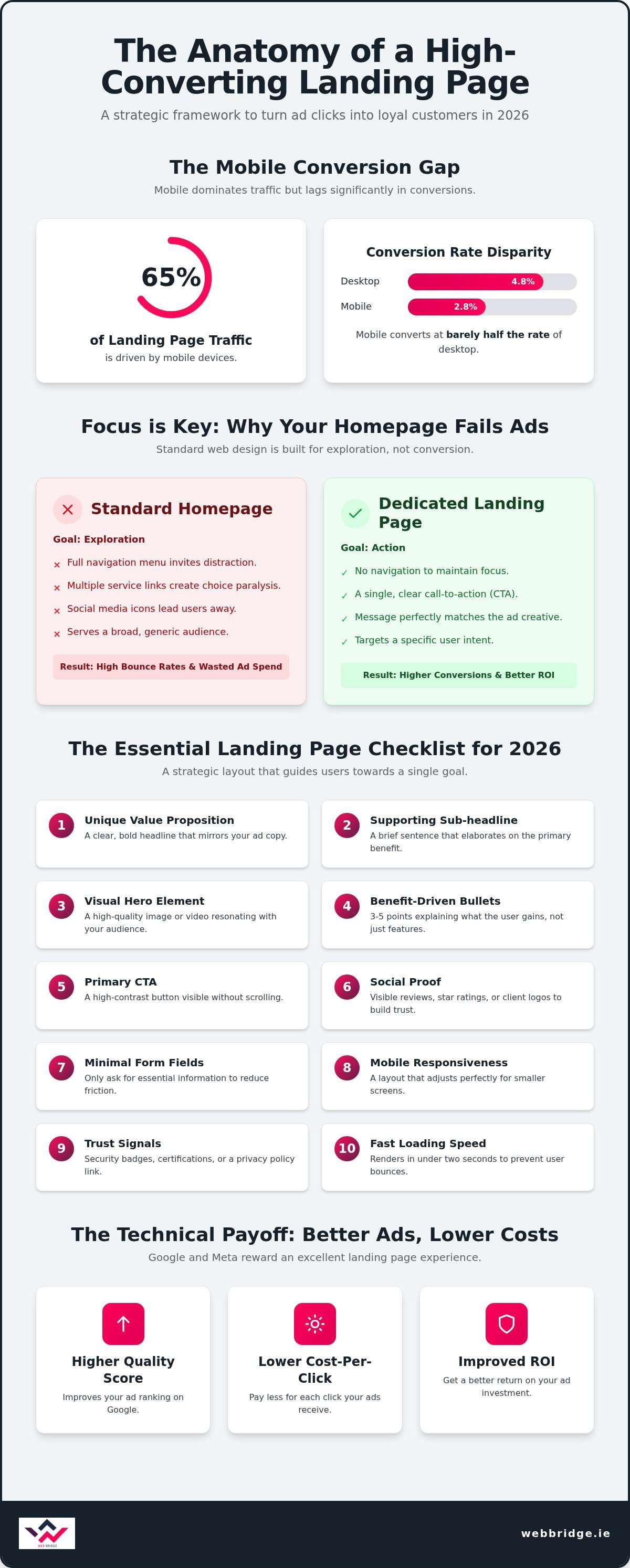
Many business owners make the mistake of sending paid traffic to their homepage. It feels logical; your homepage is the face of your brand. However, standard web design is built for exploration, whilst effective landing page design for ads is built for a single, specific action. When a visitor arrives via a targeted ad, they have a specific intent. If your page presents them with a navigation menu, social media icons, and multiple service links, you trigger the “Paradox of Choice”.
Instead of converting, the visitor becomes overwhelmed and leaves. This confusion has a direct financial cost. You’ve already paid for that click. If the user bounces because they couldn’t find the exact offer promised in your ad creative, that money is gone forever. High bounce rates aren’t just a metric; they’re a leak in your marketing budget that needs to be plugged.
The Homepage vs. Landing Page Debate
A landing page differs from a homepage in its DNA. Homepages serve as digital brochures, welcoming everyone from job seekers to existing clients. In contrast, a dedicated landing page removes all distractions to keep the user on a narrow path toward conversion. It’s a focused environment where every pixel earns its keep.
The data supports this focus. In 2026, the cross-industry average conversion rate for landing pages sits between 4% and 6%. Whilst desktop equivalent pages convert at roughly 4.8%, mobile landing pages often struggle at 2.8%. Sending this traffic to a generic site page, which lacks a clear conversion hierarchy, often results in rates far below these benchmarks. For complex campaigns, we sometimes recommend a microsite to provide more depth without losing the conversion focus of our web design services.
How Poor Design Increases Your Cost-Per-Click (CPC)
Design doesn’t just affect the user; it affects the ad platform’s algorithm. Google Ads uses a Quality Score to determine how much you pay per click. A significant part of this score is the “Landing Page Experience”. If your page is slow, irrelevant, or difficult to navigate, Google will charge you more to show your ads. Your budget buys fewer clicks, and your competitors gain the advantage.
Similarly, Meta Ads penalise destination URLs that offer a poor mobile experience. With mobile traffic now accounting for 65% of landing page visits, a slow-loading page is a silent killer of ROI. By reducing friction through professional Google Ads management and better design, you lower your overall cost-per-acquisition. You stop paying for clicks that never had a chance to convert and start building a sustainable growth engine.
The Essential Landing Page Design Checklist for 2026
Building a high-converting page requires more than just a modern aesthetic; it demands a strategic layout that guides the user toward a single goal. To ensure your landing page design for ads performs at its peak, you must address both psychological triggers and technical requirements. Use this 10-point checklist to audit your current pages and identify where you might be losing potential leads.
- Unique Value Proposition (UVP): A clear, bold headline that mirrors your ad copy.
- Supporting Sub-headline: A brief sentence that elaborates on the primary benefit.
- Visual Hero Element: A high-quality image or video that resonates with your target audience.
- Benefit-Driven Bullets: Three to five points explaining what the user gains, not just features.
- Primary CTA: A high-contrast button that is visible without scrolling.
- Social Proof: Visible reviews, star ratings, or client logos to build immediate trust.
- Minimal Form Fields: Only ask for essential information to reduce friction.
- Mobile Responsiveness: A layout that adjusts perfectly for smaller screens.
- Trust Signals: Security badges, certifications, or a link to your privacy policy.
- Fast Loading Speed: A page that renders in under two seconds to prevent bounces.
If you find that your current site doesn’t meet these standards, our team can help you optimise your web design for better results.
Above-the-Fold: Your 3-Second Sales Pitch
The “above-the-fold” area is the most valuable real estate on your page. You have roughly three seconds to convince a visitor they are in the right place before they consider hitting the back button. Your UVP must be the first thing they see. It should be punchy and direct. If your ad promised “Affordable Dublin Web Design,” your landing page headline shouldn’t pivot to “Innovative Digital Solutions.” Stick to the promise.
The choice between a hero image and a video often depends on your industry. For service-based businesses in Ireland, a short, professional video often outperforms a static image by providing a human connection. However, regardless of the visual you choose, your primary call to action must be present. On mobile devices, this often means placing the button directly under the headline to ensure it isn’t buried by a large image.
Trust Signals and Credibility Builders
Anxiety is the enemy of conversion. Visitors often wonder if your business is legitimate or if your service actually works. Trust signals act as the antidote. Position your most impressive client logos or industry certifications just below the hero section. This placement validates your expertise early in the user journey.
Real customer feedback is even more powerful. Whilst written testimonials are helpful, integrated video production can transform your credibility. Seeing and hearing a real person discuss their positive experience removes a massive layer of doubt. It makes your brand feel approachable and reliable. When users see that others have successfully navigated the “bridge” from a problem to a solution, they are far more likely to follow suit.
Mastering Message Match: The Psychology of Ad Alignment
Message match is the psychological bridge between an ad click and the final conversion. It ensures that when a user arrives at your destination, the experience feels like a natural continuation of the ad they just clicked. If there’s a disconnect between the two, you lose trust instantly. This often leads to “pogo-sticking,” where users immediately bounce back to search results. When this happens, you’ve paid for a click that had zero chance of converting because the “scent trail” went cold.
The “Scent Trail” theory describes the user’s need for consistency throughout their journey. To keep them on the path, your landing page design for ads must mirror the visual and emotional cues of your creative assets. If your ad promises an “Instant 2026 Price Guide,” that guide should be the primary focus of the page. Aligning emotional triggers is equally vital. If your ad targets the pain of high energy costs, your landing page must deliver the solution immediately. Don’t make the user hunt for the promise you made in the ad copy.
Visual Continuity and Brand Harmony
Consistency builds confidence. You must use the same colour palette, typography, and imagery style across your ad creative and your page design. If your Meta ad features a specific professional video, that same video or a related frame should appear prominently on the landing page. As a leading social media marketing agency in Ireland, we’ve seen how cohesive ad-to-page strategies significantly lower bounce rates. A professional, high-authority ad must lead to a page that reflects that same level of expertise. Any shift in tone or style creates friction that stops a conversion in its tracks.
Copywriting for the Skim-Reader
Most visitors won’t read every word on your page. They scan. Eye-tracking studies show that users often follow an “F-pattern,” scanning horizontally across the top and then moving down the left side of the screen. You should design your layout to accommodate this behaviour. Use bold sub-headers and bullet points to guide the eye toward your conversion goal. Mirror the specific keywords used in your Google Ads campaign. This doesn’t just reassure the user they’re in the right place; it also signals relevance to the ad platform, which can help improve your Quality Score. Keep your sentences punchy and your value propositions immediate to maintain momentum from click to close.
Technical Optimisation: Speed, Mobile, and Accessibility
Technical execution is the engine room of your conversion strategy. You can have the most beautiful landing page design for ads in the world, but if it takes five seconds to load, most users will never see it. In Ireland, where mobile connectivity varies, page speed is the number one silent killer of ad ROI. Research from 2026 shows that a one-second improvement in mobile load time can increase conversions by up to 20%. Pages that load in under one second convert roughly 2.5 times higher than those taking five seconds or more. If you’re paying for every click, every millisecond counts.
Google Ads also pays close attention to Core Web Vitals. These metrics measure how quickly your page becomes interactive and how stable the layout remains as it loads. A poor technical experience triggers a lower Quality Score, which directly increases your cost-per-click. By focusing on these technical signals, you aren’t just helping the user; you’re actively making your ad spend more efficient.
The Need for Speed: Slashing Load Times
Bloated assets are the primary culprit behind slow destination URLs. High-resolution images and uncompressed videos create friction that drives up your bounce rate. We prioritise Dublin-based hosting for our Irish clients because physical proximity to the local audience reduces latency. This ensures your content reaches the user’s screen with minimal delay. If your current site feels sluggish, our website repair and maintenance services can strip away the technical debt that’s holding you back.
Mobile-Responsive vs. Mobile-First
Mobile now accounts for 65% of landing page traffic, yet mobile conversion rates often lag at just 2.8% compared to 4.8% on desktop. A mobile-responsive design simply shrinks a desktop layout; a mobile-first approach builds specifically for the handheld experience. Navigation must be “thumb-friendly,” with large, easy-to-tap buttons that prevent accidental clicks. Forms must be simplified to the absolute essentials. Data suggests that three-field forms convert 25% better than nine-field forms. For businesses running Meta Ads, where mobile traffic often exceeds 70%, a flawless handheld experience is no longer optional.
Accessibility is another vital conversion tool that many businesses overlook. Following WCAG 2.1 Level AA standards ensures your page works for every potential customer, regardless of their ability or device. This inclusivity broadens your reach and signals professional execution to both users and ad platforms. Is your technical performance costing you customers? Audit your landing page with our Google Ads experts to stop the budget leaks today.
Professional Landing Page Design with Web Bridge
Web Bridge acts as the vital link between your marketing budget and your business growth. We don’t just build pages; we engineer conversion environments. By integrating ad strategy with high-performance web design, we ensure that every click has the best possible chance of becoming a lead. Being a Dublin-based agency, we understand the specific nuances of the Irish market, from local search behaviour to the expectations of Irish SMEs.
Our Conversion-First Design Process
Our process starts with wireframes focused on a clear conversion hierarchy. We then move to a fully optimised, high-speed build. We don’t stop at the launch. We use heatmaps and user recordings to see exactly where visitors click and where they drop off. This data-driven approach allows us to refine your landing page design for ads continuously. By watching how users interact with your content, we can move high-performing elements to more prominent positions and remove friction points. You can learn more about our build process by visiting our web design page.
Scaling Your ROI with Managed Ads
Scaling your ROI requires a unified strategy. Fragmented freelancers often work in silos; the designer doesn’t talk to the ad manager. This leads to the disconnects that kill conversion rates. At Web Bridge, we provide expert Google Ads management alongside our design services. This integration ensures that the scent trail remains unbroken from the first impression to the final thank-you page. We aren’t just an anonymous service provider; we’re a local partner invested in your success.
Our team has helped local businesses reduce their cost-per-acquisition by aligning their destination URLs with their campaign goals. This holistic approach, which can also incorporate video production and local SEO, ensures your business grows across all digital channels. We prioritise tangible improvements in visibility and engagement because we know that at the end of the day, your bottom line is what matters most. Stop settling for expensive clicks and start building a presence that converts.
Maximise Your Marketing ROI in 2026
Successful digital growth requires a strategic shift from a passive web presence to an active conversion engine. You now understand that standard homepages often leak budget, whilst a dedicated landing page design for ads ensures every click has a clear, profitable path to follow. By prioritising mobile-first speed, technical accessibility, and perfect message match, you create a seamless journey that builds immediate trust with your audience.
As Dublin-based experts in ROI-focused design, we specialise in high-performance Google and Meta campaigns. Our holistic approach integrates full-service video production with custom web development to ensure your brand stands out in a crowded Irish market. Don’t let technical hurdles or inconsistent branding drain your ad spend. It’s time to bridge the gap between expensive traffic and tangible revenue. We’re ready to help you turn those clicks into long-term customers.
Book a Conversion Audit with Web Bridge Today to transform your digital strategy and start scaling your business with confidence.
Frequently Asked Questions
What is the most important element of a landing page for ads?
The most important element is the “message match” between your ad creative and your headline. When a user clicks your ad, they expect to see exactly what was promised immediately. A strong unique value proposition that mirrors your ad copy reduces bounce rates and builds trust so it’s easier to convert. Your landing page design for ads must communicate this value in under three seconds to capture attention effectively before the user leaves.
Should I use my homepage as a landing page for Google Ads?
You should almost never use your homepage for paid ad traffic. Homepages are designed for general exploration and don’t focus on a single goal. They contain too many distractions, such as navigation menus and social links. This creates a “paradox of choice” that confuses visitors. A dedicated landing page focuses on a single action, which is far more effective for converting targeted traffic into leads for your Dublin business and ensuring your budget works harder.
How long should a landing page be for a lead generation campaign?
The ideal length depends on the complexity of your offer and the level of commitment required. For a simple newsletter signup or a free guide, a short page with minimal fields usually converts best. However, for high-value services that require more trust, a longer page with detailed testimonials and proof points is necessary. We always recommend testing different lengths to see what resonates best with your specific Irish audience and your business goals.
Does landing page speed really affect my ad costs?
Yes, page speed directly impacts your Google Ads Quality Score and your overall cost-per-click. Google penalises slow-loading pages because they provide a poor user experience. If your page takes longer than three seconds to load, you’ll likely pay more for every click whilst seeing a significant drop in conversions. Technical optimisation is a vital part of landing page design for ads that helps you maintain a competitive edge and maximise your marketing budget.
What is a good conversion rate for a professional landing page?
A good conversion rate for a professional page in 2026 typically ranges between 5% and 10%. Whilst the cross-industry average is between 4% and 6%, top-performing pages often achieve 11% or higher. These figures vary depending on your specific industry in Ireland. For example, SaaS companies often see higher rates than financial services. Focus on continuous improvement rather than just hitting a single industry benchmark to ensure your business continues to grow.
How often should I A/B test my landing page design?
You should aim to test your design monthly or whenever you have enough traffic to reach statistical significance. Testing high-impact elements like your main headline, hero image, or call-to-action button colour provides the most useful insights. Continuous testing allows you to adapt to changing user behaviour and ensures your marketing spend remains efficient. Small changes can often lead to substantial improvements in your overall return on investment and customer engagement.
Can I use video on my landing page without slowing it down?
You can certainly use video effectively by employing modern optimisation techniques like lazy loading and compressed formats. Hosting your video on a dedicated platform and embedding it correctly prevents it from bloating your initial page load time. Professional video is a powerful tool for building trust quickly. It allows you to demonstrate your expertise and connect with potential customers in Dublin without compromising your technical performance or search engine visibility.
Do I need a different landing page for Facebook ads and Google ads?
Yes, you should tailor your pages to match the specific intent of each platform. Google Ads traffic is usually high-intent and search-driven, whilst Meta Ads traffic is often discovery-based. A user coming from a search query might want immediate technical details, whereas a social media user might respond better to emotional storytelling and visual social proof. Customising your approach for each channel ensures your message resonates perfectly with the visitor so it’s easier to improve your conversion rates.