
A website quote isn’t a price tag for a standard product. If you’re asking “how much does a website cost Dublin 2026”, the useful answer depends on what you need built, how tailored it must be and what happens after launch. Two proposals can look similar at first glance yet cover very different work.
It’s understandable to want a clear figure before committing. But page count alone won’t show whether a quote includes the right features, content support, hosting or ongoing maintenance. Without clear requirements, it can also be hard to judge whether a straightforward business site will do the job or whether your plans need a more tailored build.
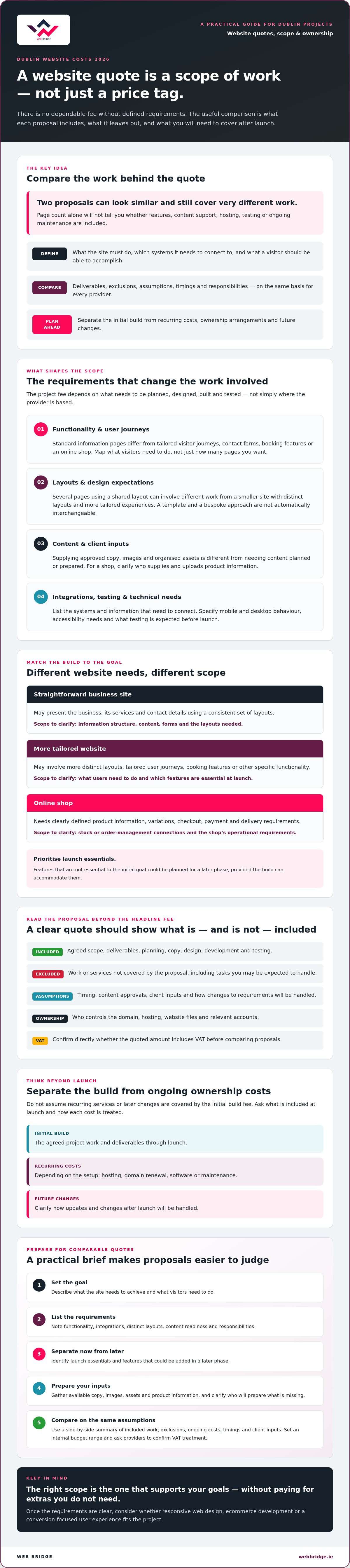
This guide explains the main website cost drivers, how to define a practical scope and how to compare proposals from Dublin providers on consistent assumptions. You’ll also learn what to check about recurring costs and future changes, so the initial fee doesn’t tell the whole story. We’ll look at how requirements differ for business and ecommerce websites, helping you prioritise what supports your goals and avoid paying for extras you don’t need.
Key Takeaways
- There’s no single answer to “how much does a website cost Dublin 2026”; define functionality, integrations and responsibilities to make proposals meaningful.
- Look beyond page count: map distinct layouts and user journeys, then separate launch essentials from features you could add later.
- Compare proposals side by side, checking deliverables, exclusions, timings and who controls key accounts and website assets.
- Set a realistic internal budget range, clarify your goals and prepare content or other assets before requesting comparable quotes.
- Once your scope is clear, consider whether responsive web design, ecommerce development or conversion-focused user experience fits your project.
Dublin Website Costs 2026: Understanding Your Quote
There’s no dependable fee for a website without a defined scope. If you’re asking “how much does a website cost Dublin 2026”, the answer depends on what the site needs to do, which tasks are included and who is responsible for each part. Being based in Dublin doesn’t, by itself, determine the project fee.
Start by listing the requirements. Functionality, integrations, content readiness and design expectations all affect the work involved. A site with a few standard page layouts differs from one with tailored user journeys, booking features or an online shop. Connecting payment, stock or customer systems may require additional planning and development.
It also helps to understand what goes into a finished site. The web development process can involve front-end work, which shapes what visitors see and use, and back-end work, which supports the site’s functionality. Providers may divide strategy, copy, design, development and testing differently. As a result, two quotes can describe different work even when they appear to cover a similar website.
Separate the initial build from ongoing ownership costs. Depending on the setup, you may need to budget for hosting, domain renewal, software or maintenance, as well as future updates. Ask what is included at launch, which costs recur and how later changes are handled. Don’t assume these arrangements are covered by the build fee.
Why two Dublin website quotes can be very different
A straightforward brochure site might present a business, its services and contact details using a consistent set of layouts. A bespoke website or online shop may need more tailored journeys, product information, checkout requirements or integrations. Content readiness affects the workload too: supplying approved copy and organised assets differs from needing content planned or prepared.
One provider may include planning and testing in its proposal, while another may list them separately or expect you to handle some tasks. Compare the work, not just the labels.
What a website quote should make clear
Ask each provider to document the agreed scope, deliverables, exclusions, timing assumptions and your responsibilities. Check who supplies and approves content, what happens if requirements change, and who will control the domain, hosting, website files and relevant accounts. Confirm directly whether the quoted amount includes VAT, then compare proposals on the same basis.
For a useful comparison, summarise each proposal in a simple table: included work, exclusions, ongoing ownership costs, timings and client inputs. This makes gaps easier to spot and helps you choose a scope that fits your goals, rather than relying on the headline fee alone.
Which website requirements have the biggest effect on your Dublin project budget?
Page count gives only part of the picture. A site with several pages using the same layout may involve less work than a smaller site with distinct layouts, audience journeys and interactive features. If you’re considering how much does a website cost Dublin 2026, map what each visitor needs to do, not just how many pages you want.
Prioritise what the site must do at launch. A clear service site may need contact forms and well-organised information, while an online shop also needs defined product, checkout and operational requirements. Features that aren’t essential to your initial goals could be planned for a later phase, provided the build can accommodate them.
How design, content and functionality change the scope
Adapting an established template can provide a consistent structure; a tailored user experience may require more detailed planning and distinct layouts. Neither approach is automatically right. Match the design scope to your audience and business goals.
Clarify who supplies the copy, images and, for a shop, product information, and who prepares or uploads these for launch. List each required feature, such as forms or booking tools, and identify the systems it must connect to. Integration work depends on the systems involved and the information that needs to pass between them.
Also specify responsive behaviour across mobile and desktop, accessibility needs and the testing required before launch. For an online shop, define product variations, payment and delivery requirements, and any stock or order-management connections. These details help make ecommerce website development a clearly scoped part of the project rather than an undefined add-on.
What to define before requesting a Dublin website quote
Prepare a short project brief before contacting providers. Include:
- Purpose and audience: What should the site help people understand or do, and who are its priority visitors?
- Structure and outcomes: List required pages and state the business goals you want the site to support.
- Assets and systems: Note available content, images and existing tools that may need to connect to the site.
- Launch essentials: Identify required features, accessibility needs, responsive expectations and testing.
Then mark each requirement as essential or optional. This gives providers a consistent brief and helps them explain which tasks shape their proposals. For broader context on choosing a provider, read the 2026 Dublin web design guide.
How can you compare Dublin website quotes without choosing on price alone?
The lowest headline fee may not cover the same work as another proposal. One quote might include content entry and testing, while another assumes you’ll handle them. Compare like for like: ask each provider to price the same brief, then review what’s included, excluded and expected from you.
A side-by-side comparison makes gaps easier to spot. Use a simple table to record:
- Scope and deliverables: Pages, layouts, features, integrations and testing.
- Exclusions and responsibilities: Who supplies content, approves work and completes tasks outside the proposal.
- Stages and timing: Milestones, approval points and assumptions about how quickly you’ll provide feedback or materials.
- Ownership and access: Who controls the domain, hosting, website files, content and relevant accounts.
- Support: What handover materials, training or post-launch help are included, if any.
Ownership matters. Confirm that you’ll have the access needed to manage the domain and relevant accounts, and ask how website files and content will be handed over if you change provider. Clear answers now can make future updates or a move to another provider more straightforward.
A practical checklist for assessing each proposal
Check that every provider has priced the same requirements and assumptions. Ask how revisions are limited or billed, how scope changes are approved, and what happens if feedback or materials arrive later than planned. Look for a clear sequence of project stages, with approval points and testing described in writing. Confirm exactly what handover help is offered rather than assuming it’s included.
One-off build costs versus ongoing website costs
Separate the initial project work from recurring expenses. Depending on the setup, hosting, software licences, maintenance and content updates may be billed separately, handled by different providers or not included at all. Ask what each ongoing service covers, whether it’s optional, who provides it and how charges are calculated. Don’t treat a mention of support as a defined maintenance arrangement. For context, review information about website repair and maintenance when deciding what support questions to ask.
Use the comparison to weigh the full scope and ownership terms, not just the first invoice. If you’re looking for a partner to help shape a responsive site around your goals, explore Web Bridge’s web design as one option to assess against your brief.
How should you plan a website budget and request comparable quotes in Dublin?
A clear brief helps providers estimate the same project and gives you a more useful basis for comparing proposals. It also helps answer “how much does a website cost Dublin 2026” for your requirements, rather than relying on a generic figure.
Use this process to get ready:
- Define the outcome. Decide what the site should help your business achieve and what visitors should do, such as enquire, book or browse products.
- Separate must-haves from enhancements. Identify what needs to work at launch, then list useful additions that could be scoped for a later phase.
- Prepare your assets. Gather existing copy, images, product details and information about systems the website may need to connect with. Note what still needs to be created or organised.
- Set an internal budget range. Agree what your business can realistically invest, including any ongoing costs you’ve identified. You don’t need to publish that range, but it can help you assess scope and trade-offs.
- Request comparable proposals. Send each Dublin provider the same brief and ask them to state assumptions, exclusions, VAT treatment and payment milestones in writing.
Build a brief that helps agencies scope the work
Describe your business, audience, services or products, and the action you want visitors to take. List the required pages, functionality, integrations and launch priorities. Be clear about which content and assets are ready and which need preparation. Finally, explain what success should look like and name the person who’ll approve work and provide feedback for your business.
Questions to ask before choosing a website partner
Ask who will manage design, development, testing and launch, and how progress and decisions will be communicated. Confirm who owns the domain, website files and content, what access you’ll receive, and what handover is included. Clarify who is responsible for technical upkeep after launch, and whether any ongoing support is optional or separately billed.
Compare the clarity and fit of each response, not just the total. A proposal that explains responsibilities, stages and assumptions gives you a stronger basis for planning than one that leaves key details open. If you’re ready to shape your requirements into a website brief, talk to Web Bridge about your web design project.
Where does Web Bridge fit when you need a website in Dublin?
Once you’ve defined the project and know how you’ll assess proposals, you can decide which provider is suited to the work. Web Bridge is an Ireland-based digital marketing and web design agency serving Dublin. Its services include responsive web design, ecommerce development and design focused on user experience and conversion optimisation.
A useful discussion starts with your goals and requirements, not a generic price. If you’re still asking “how much does a website cost Dublin 2026”, share the scope you’ve prepared and ask how the proposed work maps to it. Confirm what the proposal includes, what remains your responsibility and which ongoing costs, if any, sit outside the initial build.
When a web design and ecommerce partner may suit your project
If you need a tailored responsive site, discuss the layouts, visitor journeys and launch essentials that matter to your business. You can explore Web Bridge web design services as a starting point for assessing whether its approach fits your brief.
For an online shop, define the catalogue, product information, checkout and operational needs before requesting a proposal. Consider whether the site needs to connect with existing tools for payments, stock or order management, and ask providers to state clearly which requirements they’ve allowed for. This detail keeps the ecommerce scope specific and makes proposals easier to evaluate.
Plan beyond launch without adding services you don’t need
A new website doesn’t automatically require every marketing service. Consider SEO or advertising only in relation to separate business goals, priorities and budgets. If improving local discoverability in Dublin is part of your plan, you can review local SEO services in Ireland as a separate consideration, rather than treating it as a compulsory part of web design.
Keep your next step simple: share your brief, launch priorities and questions with Web Bridge, then request a proposal based on that scope. Ask for assumptions, deliverables, exclusions, VAT treatment and payment milestones in writing. You’ll be better placed to judge whether the proposed work suits your business, what it covers and how it compares with other options. A clear brief supports a more useful conversation, without committing you to extras that aren’t right for your plans.
Move from a rough budget to a clear project plan
The question “how much does a website cost Dublin 2026” is best answered with a defined scope, not a one-size-fits-all figure. Your requirements, content, functionality and responsibilities shape the proposal, so prepare a clear brief before comparing providers.
Assess quotes side by side. Check that they cover the same deliverables, assumptions, exclusions and VAT treatment, and clarify ownership, ongoing costs and post-launch responsibilities. A lower headline fee may leave important work outside the proposal.
Web Bridge offers web design and ecommerce development, with responsive websites tailored to business needs and a focus on user experience and conversion. SEO and digital advertising are also available as separate services if they fit your growth goals. Share your priorities and questions to explore whether the scope is a good match, then request a tailored proposal.
Discuss your Dublin website project with Web Bridge and take the next step towards a site built around your business goals.
Frequently Asked Questions
How much does a website cost in Dublin in 2026?
There’s no single dependable price without knowing the website’s scope. For “how much does a website cost Dublin 2026”, start by defining what the site needs to do, its content and layouts, and any features or integrations required. A straightforward business site and an online shop involve different requirements. Request proposals based on the same brief, then check included work, exclusions, VAT treatment and ongoing costs.
What makes one website quote more expensive than another?
Quotes can differ because they cover different work. Custom layouts, specific user journeys, forms, booking tools, ecommerce features and integrations can all affect project scope. Content readiness matters too: supplying prepared copy and images differs from needing help organising and adding content. Providers may also include different amounts of planning, design, development and testing. Ask each to explain its assumptions and deliverables so you can compare the actual work.
Does a website quote in Ireland include VAT?
Not necessarily. A proposal should state clearly whether its quoted amount includes VAT, but don’t assume either way. Ask each provider to confirm the VAT treatment in writing before comparing totals or agreeing to proceed. Check that you’re comparing proposals on the same basis, especially if one quote presents a total including VAT and another lists it separately. This helps you understand the amount payable without making assumptions about what the headline figure covers.
What ongoing costs should I budget for after my website launches?
Plan for possible recurring costs such as domain renewal, hosting, software or other licences, maintenance and content updates. What applies depends on the website’s platform and arrangements with your provider. Ask which items are included in the initial project, which are optional, who supplies them and how they’re billed. Also clarify how future changes are handled, so you can distinguish ongoing ownership costs from new work requested after launch.
Is a template website cheaper than a custom website?
A template can reduce the need to create every layout from scratch, but the overall project still depends on the required content, functionality, integrations and preparation. A custom approach may better support distinctive user journeys or business requirements, but needs to be scoped accordingly. Ask providers what they mean by “template” or “custom”, what can be tailored, and whether future changes or added features are covered in the proposal.
How do I compare website design quotes fairly?
Give each Dublin provider the same written brief, then compare scope, deliverables, exclusions, timing assumptions and your responsibilities side by side. Confirm who controls the domain, hosting, website files, content and relevant accounts. Ask how revisions, scope changes, testing, handover and post-launch support are handled. Check whether VAT is included and separate any recurring costs from the build. This makes it easier to judge the value of the work, not just the headline fee.
How long does it take to build a business website?
There isn’t one reliable timeframe for every business website. The schedule depends on the agreed scope, functionality, integrations, content readiness, testing and how quickly feedback and approvals are provided. Ask the provider to set out project stages, key approval points and timing assumptions in writing. Check what could delay progress, such as missing content or late decisions, and confirm what needs to be ready from your side before work begins.