
What if the page you’re ready to redesign isn’t the one costing you the most customers? The right improvements come from understanding where visitors hesitate and what they’re trying to do, not from copying the latest design trend. That’s the starting point for effective website conversion rate optimization.
If you’re unsure which pages or journeys are underperforming, conflicting advice can make it harder to act. A rise in clicks or form starts means little if it doesn’t support a meaningful business goal. Connect visitor behaviour with outcomes such as enquiries or sales, then choose improvements based on evidence.
This practical guide will help you measure conversions, identify likely barriers and use an audit template to decide what to tackle first. You’ll learn when to make a considered improvement, when an experiment is useful and when specialist support may help. Whether you run an ecommerce store or a service business in Dublin or elsewhere in Ireland, you’ll have a repeatable way to turn observations into clear next steps.
Key Takeaways
- Set a clear business goal before measuring conversions, and distinguish valuable outcomes from smaller steps that support them.
- Check tracking, event definitions, consent behaviour and data quality before drawing conclusions from website activity.
- Choose a research method or test that fits the question, evidence available, effort and risk involved.
- Use a repeatable website conversion rate optimization audit to record evidence, identify friction and prioritise a practical next step.
- Review results over time, accounting for changes in traffic, offers, seasonality or tracking before deciding whether a change worked.
What Website Conversion Rate Optimisation Means for Your Business
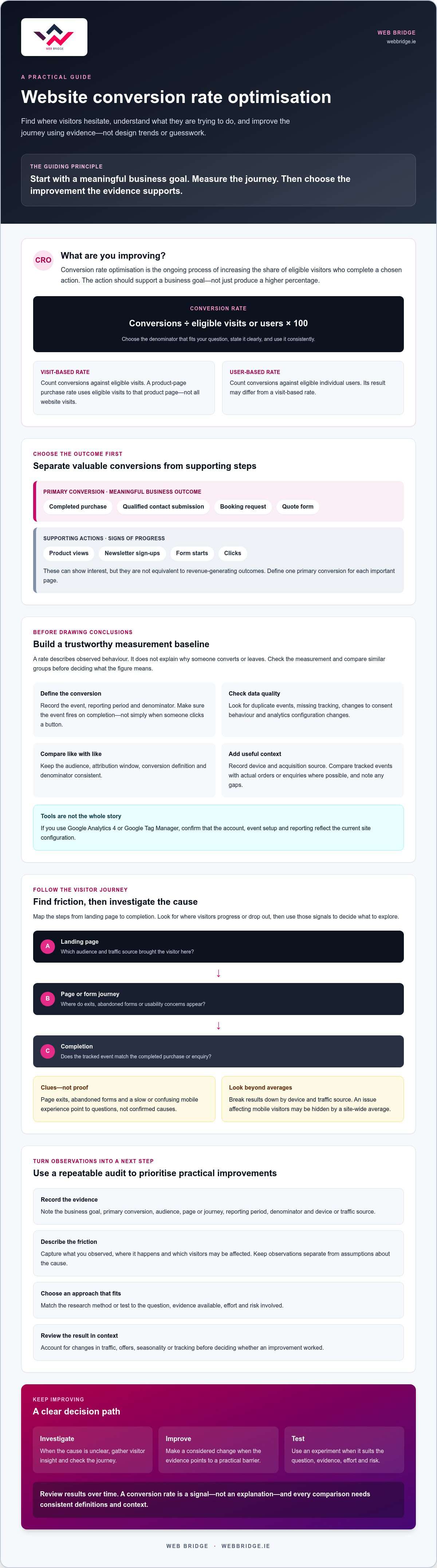
Conversion rate optimisation is the ongoing process of improving the share of visitors who complete a chosen action on your website. It starts with a business goal, then uses measurement and visitor insight to guide improvements. For a neutral overview of the discipline and its core methodology, see What Website Conversion Rate Optimisation Means.
Calculate the rate by dividing conversions by eligible visits or users, then multiplying by 100. State which denominator you use and apply it consistently. For example, if you measure completed purchases against eligible visits to a product page, use those page visits as the denominator, not all website visits. A user-based rate counts eligible individual users instead, so the result may differ.
Website conversion rate optimization isn’t about pursuing a percentage in isolation. A rate reflects a particular audience, traffic source, device, page and action. Visitors arriving from a campaign may behave differently from people finding a store through organic search. Mobile shoppers may have a different experience from desktop users. Compare like with like, and check whether conversions contribute to outcomes such as sales or qualified enquiries.
Which website actions count as conversions?
Choose actions that fit your business model. For an Irish online store, a completed purchase may be the primary conversion. For a service business, it could be a qualified contact submission, booking request or quote form. Product views and newsletter sign-ups can show interest, but they aren’t equivalent to revenue-generating outcomes. Define one primary conversion for each important page, then track supporting actions that show progress towards it.
What conversion rate can and cannot tell you
A conversion rate describes observed behaviour: how often eligible visitors complete the action you’re tracking. It doesn’t explain why someone converts or leaves. A lower rate may prompt questions about the offer, page content, usability or traffic quality, but the figure alone can’t identify the cause.
Before comparing results, check that the audience, attribution window, conversion definition and denominator match. A rate based on users isn’t directly interchangeable with one based on visits. Likewise, a product-page purchase rate answers a different question from a whole-site enquiry rate. Treat the figure as a signal, then investigate the visitor journey for evidence about what to improve.
Measure Website Conversion Problems Before Changing the Design
Start with the business outcome, not a design idea. Decide whether the priority is completed purchases, qualified enquiries or another meaningful action. Then identify the audience you want to convert and the page or journey responsible. For an Irish online store, that might mean checking how visitors from a particular campaign move from a product page through checkout, rather than relying on the site-wide conversion rate.
Build a conversion measurement baseline
Before interpreting results, write down the conversion event, reporting period and denominator. Record device and acquisition source too, so you can compare similar groups over time. Check that the event fires when the action is completed, not simply when someone clicks a button. Look for duplicate events, missing tracking and changes to consent behaviour or analytics configuration that could affect what gets recorded.
If you use Google Analytics 4 or Google Tag Manager, confirm that the account, event setup and reporting reflect the current site configuration. Don’t assume a dashboard tells the whole story: compare tracked events with actual orders or enquiries where possible, and note any gaps. A reliable baseline makes website conversion rate optimization more evidence-led and less dependent on guesswork.
Find friction in the visitor journey
Map the steps from landing page to completion, then compare where visitors progress or drop out. Page exits, abandoned forms and a slow or confusing mobile experience are clues, not proof of the cause. Break results down by device and traffic source. For example, a checkout issue affecting mobile visitors may be hidden by a site-wide average.
Use those signals to decide what to investigate. Observe people using the journey, review customer questions and gather usability feedback. If shoppers ask about delivery details, check whether that information is easy to find before checkout. Treat heatmaps, correlations and individual comments as evidence to explore, not a verdict. A research paper on advanced CRO research methods illustrates how technical approaches can inform optimisation, but reliable measurement and a clear business question remain essential starting points.
Once evidence points to a specific page or experience, consider whether a focused website design improvement could address the friction. Be clear about the reason for the change, then monitor the same conversion event and audience to assess the outcome.
Choose the Right CRO Method: Research, Quick Fixes or A/B Testing
The best method depends on what you need to find out, the evidence you already have and the risk of making a change. Website conversion rate optimization doesn’t mean testing every button or rebuilding the whole site. Often, the useful next step is a focused investigation or a straightforward correction.
Match the method to the question:
- Analytics review: Where in the journey are visitors leaving, and does the pattern vary by device or traffic source?
- User research: What do customers expect, understand or find unclear? Interviews and support queries can reveal needs that numbers can’t explain.
- Usability checks: Can people complete a task, such as finding a product or submitting a booking request, without confusion?
- Expert review: Are there apparent issues with page clarity, navigation or the steps to completion that need closer inspection?
- Controlled experiment: Does one version of a page or element lead to a better outcome than the current version?
Consider the question, strength of evidence, implementation effort and risk together. If a checkout step is broken, fix it rather than delaying the repair to run a test. If evidence suggests customers can’t find delivery information, investigate the journey and make the details easier to find. If two plausible layouts could solve the same issue, a controlled comparison may help you choose.
When should you test a change against the current page?
Run an A/B test when you have a clear hypothesis, reliable measurement and enough eligible visitors and conversions for a meaningful comparison. Define one primary metric before launch, such as completed purchases, alongside guardrails such as average order value or checkout errors. This can reveal whether a change improves the main measure while harming another important outcome.
Low traffic or few conversions can make test results too uncertain to guide a decision. Don’t declare a winner early because one version briefly leads. Normal fluctuations can look persuasive in a small sample. Set your decision approach in advance and allow the experiment to gather enough evidence for a fair comparison.
When are research-led improvements more practical?
Use interviews, usability observation and customer support questions when you need to understand why people hesitate. If shoppers repeatedly ask about delivery, check whether the information is visible where they need it. Correct confirmed errors, accessibility barriers or broken journeys promptly. If a formal experiment isn’t practical, record your assumption, make a considered change and monitor the outcome against your baseline.
Use This Website Conversion Rate Optimisation Audit Template
Turn observations into decisions with a repeatable sequence: goal, audience, page, evidence, friction, hypothesis, action and measurement. For each page, name the business outcome, who the page serves and what evidence suggests a barrier. Record the change you’ll make, how you’ll assess it and when you’ll review the result. This keeps website conversion rate optimization focused on customer impact rather than design preferences.
Audit a landing page, product page or enquiry form
Check that the page matches visitors’ expectations, explains its value clearly and provides relevant proof. Make sure calls to action are easy to understand and that distractions don’t pull attention away from the intended next step. On mobile, review readability, interaction, page errors and the effort required to complete a form. For ecommerce, check that product details, delivery information and checkout steps are clear and connected.
Use the table to capture findings. Rate effort and risk consistently, such as low, medium or high, then prioritise issues with strong evidence and customer impact that are feasible to address and reverse if needed.
| Observation | Supporting evidence | Proposed change | Effort | Risk | Owner |
|---|---|---|---|---|---|
| Delivery details are hard to find on a product page | Customer questions and journey review | Make delivery information easier to locate | Low | Low | Assigned team member |
For every action, choose one measurable outcome, such as completed purchases or submitted qualified enquiries, and set a review date. Avoid forecasting a lift without evidence. If the change could affect another important outcome, record that as a guardrail too.
Turn audit findings into testable hypotheses
Write each hypothesis in a simple structure: “Because [evidence] suggests [barrier], changing [element] on [page] should help [audience] complete [intended behaviour].” Add the primary measure and any guardrail. For example, if mobile visitors struggle to use an enquiry form, simplifying its fields could help them submit it. Completed qualified enquiries could be the primary measure, with submission errors as a guardrail.
Use this record to compare ideas and choose a practical next step, whether that’s a correction, a page improvement or a test. For further guidance on planning a clear, user-focused site, see professional web design in Dublin. If your audit points to broader page or journey improvements, explore Web Bridge’s web design services.
Keep Improving Conversions and Know When to Get Expert Help
Conversion work is most useful as a steady cycle, not a one-off redesign. Review the evidence, prioritise an issue, implement a considered change, monitor the outcome and record what you learned. That record helps you distinguish an improvement worth keeping from a change that needs adjusting or reversing. It also gives your next website conversion rate optimization decision a clearer starting point.
Keep context alongside the results. A new campaign can bring a different mix of visitors, a changed offer can affect purchase intent, and seasonal demand can shift between periods. Changes to tracking or consent configuration can also alter what’s measured. Note these factors when reviewing performance, and don’t attribute every movement in conversions to a page update alone.
Coordinate website improvements with acquisition channels
Check that each landing page reflects the promise visitors saw in search results or an advert. If a campaign promotes a particular product or offer, make that next step clear on the page. Where paid traffic is part of the journey, Google Ads campaign management can help align campaign activity with landing-page messaging.
Keep organic visibility and conversion outcomes distinct: more search visits don’t automatically mean more purchases or enquiries. For businesses serving a local area, local SEO support in Ireland may help with local visibility, while conversion review focuses on what visitors do after they arrive. For a Dublin business, assess local visitors as a relevant audience rather than assuming their needs match those of every other visitor.
Choose practical next steps for your business
Start with one high-value journey, such as a key product-to-checkout path or an enquiry form. Document its baseline, select a specific barrier to address and set a date to review the chosen measure. This keeps the work manageable and makes it easier to understand what has changed.
Specialist support may be useful if analytics remain unclear, the journey crosses several pages or systems, or your team lacks the capacity to implement and assess improvements. A website maintenance provider for businesses comparing website developers in Dublin can help translate audit findings into practical site changes. Web Bridge’s web design and ecommerce development work focuses on user experience and conversion optimisation, without promising a particular result.
If you’ve identified a journey that needs a closer look, discuss a conversion-focused website as a practical next step.
Make Your Next Website Improvement Evidence-Led
Stronger website decisions start with a clear business outcome and reliable evidence, not a design trend or an isolated benchmark. Use the audit to identify one meaningful barrier, choose a proportionate response and track what happens. That gives your website conversion rate optimization work a practical direction, whether the next step is a correction, a page improvement or a controlled test.
Keep reviewing what you learn. Changes in traffic, offers and customer behaviour can affect results, so document the context as well as the measure. If unclear data or implementation demands are holding you back, specialist input can help turn the findings into considered improvements.
Web Bridge’s web design process focuses on user experience and conversion optimisation, with custom website and ecommerce development supported by digital marketing services. Discuss a conversion-focused website with Web Bridge and explore a practical next step for your business. Start with one well-understood journey, then build from there.
Frequently Asked Questions
What is website conversion rate optimisation?
Website conversion rate optimisation is an evidence-led process for helping a greater share of visitors complete a chosen business action. That action might be a purchase or qualified enquiry, rather than general engagement such as viewing a page. The process combines measurement, visitor insight and considered improvements. For a Dublin business, the priority is to understand whether changes support its customers and commercial goals, not simply increase activity.
How do you calculate a website conversion rate?
Divide the number of conversions by the number of eligible visits or users, then multiply by 100. State which denominator you use, as visit-based and user-based rates can differ. For example, hypothetically, 20 purchases from 1,000 eligible product-page visits gives a conversion rate of 2% for those visits. This figure describes that defined page and period, not necessarily the rate for the whole website.
What is a good website conversion rate?
There isn’t one universal rate that defines success. Results vary with sector, audience, acquisition channel, device and the conversion being measured. A purchase rate for mobile visitors from an advert isn’t directly comparable with an enquiry rate from desktop organic traffic. Set a relevant baseline for your own business, then compare like with like over time. Focus on whether the rate supports your business goals, rather than chasing an unrelated benchmark.
Can you improve conversion rates without A/B testing?
Yes. Check that conversion tracking works, review where visitors leave and use usability observation, customer feedback or support queries to investigate possible barriers. Correct verified problems, such as a broken checkout step or unclear form instruction, without waiting for an experiment. Then monitor the same conversion measure and relevant audience after the change. Without an A/B test, you can still assess what happened, but be cautious about claiming the change alone caused it.
How much website traffic do you need for A/B testing?
There’s no universal traffic threshold for a reliable A/B test. The sample needed depends on your baseline conversion rate, the effect you want to detect, the number of variations and how long the test runs. If conversions are infrequent, results may take longer to interpret and small fluctuations can mislead. Set the measurement approach in advance, and don’t call a winner based on an early lead or limited evidence.
What should a website conversion audit include?
A useful audit records the business goal, target audience and key page or journey, then checks tracking quality and reviews the steps visitors take. Bring together analytics, customer feedback and usability observations to identify possible friction. Prioritise findings by evidence, customer impact, effort and risk. For a Dublin store, document each proposed change, its intended outcome, who owns it and when you’ll review the result.
How long does website conversion rate optimisation take?
The timing depends on access to reliable data, the volume of relevant traffic, the complexity of the change and whether testing is appropriate. Fixing a confirmed page error may be straightforward, whilst gathering enough evidence for an experiment can take longer. Set a review plan that reflects the action and measure, and record changes in traffic, offers or tracking that may affect results. Avoid fixed timelines or promises of a particular outcome.